
Overview of the Criminal Court Process
Philadelphia Criminal Defense Attorney
Related Pages
Pre-Indictment Representation
Bail Hearings
Motions to Suppress Evidence
Plea Negotiations
Federal Sentencing
Pennsylvania Sentencing
Appeals & Post-Conviction Relief
Loncar Law Firm, PC
Passionate, strategic, and experienced criminal defense services in state and federal courts.
Call for a free and confidential consultation (215) 267-0500
Nicholas M. Loncar, Esq.
Criminal Justice Overview
Being accused of a crime can be one of the most overwhelming and stressful experiences a person will ever face. Many individuals entering the criminal justice system have little understanding of what to expect, how cases progress, or what rights they have at each stage of the process. Whether a case is prosecuted in Pennsylvania state court or federal court, understanding the criminal justice process is critical. This article contains a general criminal justice overview and timeline of the criminal court process. There are some variations depending on whether a case is in state or federal court, which court, and the type and severity of the charges. For information about a specific type of charge, visit the Practice Areas page for the most tailored information to your type of case.
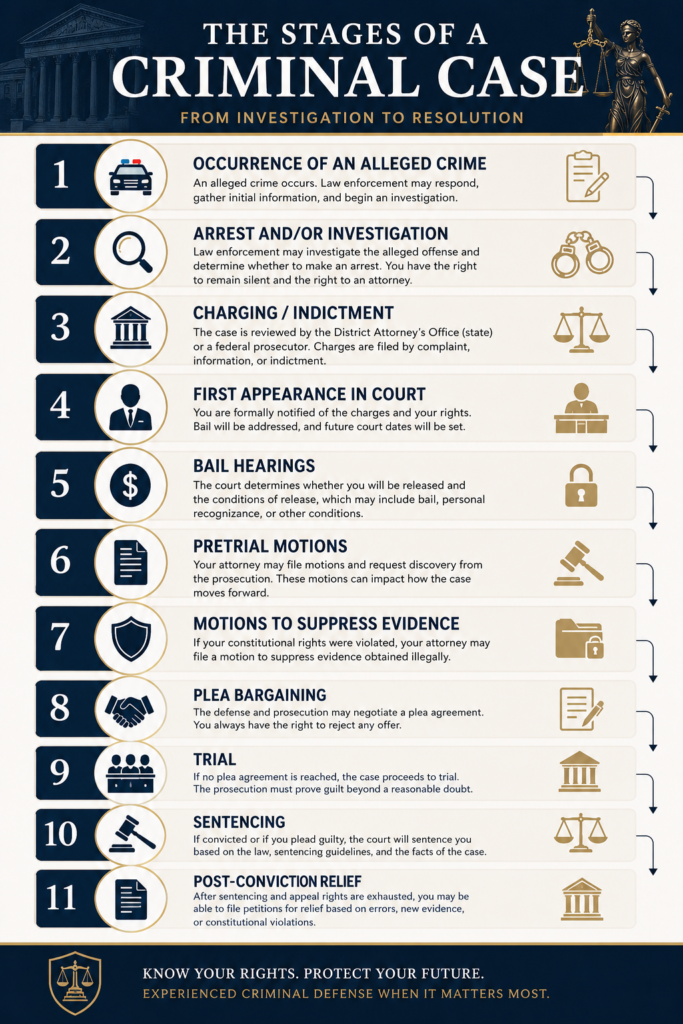
Although every case is different, criminal prosecutions generally follow a series of stages beginning with an investigation or alleged criminal incident and potentially continuing through arrest, charging, court appearances, pretrial litigation, plea negotiations, trial, sentencing, and post-conviction proceedings. An experienced criminal defense attorney can play a critical role at every step by protecting constitutional rights, challenging unlawful police conduct, and advocating for the best possible outcome.
Investigation and Alleged Criminal Conduct
The criminal justice process often begins long before anyone is arrested. In many cases, law enforcement agencies begin investigating alleged criminal activity weeks, months, or even years before charges are formally filed. Likewise, it is common for a suspect not to be aware of an ongoing investigation.
Investigations may involve police interviews, surveillance, search warrants, undercover operations, confidential informants, cellphone analysis, forensic testing, financial records, social media evidence, or grand jury investigations. Federal investigations commonly involve agencies such as the FBI, DEA, ATF, Homeland Security Investigations, IRS Criminal Investigation, or Postal Inspectors.
In some cases, individuals first learn they are under investigation when police contact them for questioning, execute a search warrant at a residence or business, or issue subpoenas for records. Statements made during this stage can significantly impact a case. Individuals contacted by law enforcement should strongly consider speaking with a criminal defense attorney before answering questions or consenting to searches.
Arrest and Filing of Charges
Criminal charges may begin with either an arrest or the filing of formal charging documents. An arrest may occur immediately after an alleged incident, after an investigation has been completed, or pursuant to an arrest warrant issued by a judge. During an arrest, law enforcement officers may seize phones, computers, vehicles, firearms, narcotics, or other alleged evidence.
In Pennsylvania state court, charges are often initiated through a criminal complaint filed by police or prosecutors. In more serious federal cases, prosecutors may seek a grand jury indictment formally charging the accused with federal offense.
After arrest, defendants are typically photographed, fingerprinted, and processed through booking procedures. Depending on the circumstances, individuals may either be released pending court proceedings or held in custody pending a bail hearing or other first appearance in court.
Preliminary Arraignment and Bail Hearings
One of the earliest court proceedings in Pennsylvania state court is the preliminary arraignment. During this hearing, the defendant is informed of the charges, advised of certain rights, and bail is addressed.
Bail decisions can have a major impact on the defense of a criminal case. Judges consider factors such as the seriousness of the charges, prior criminal history, employment, family ties, community involvement, risk of flight, and public safety concerns.
In federal court, detention hearings are governed by the Bail Reform Act. Federal prosecutors may seek pretrial detention in cases involving allegations of violence, firearms, large-scale narcotics trafficking, fraud, or other serious offenses.
An experienced defense attorney can present evidence and arguments supporting release conditions such as unsecured bail, house arrest, electronic monitoring, or other alternatives to incarceration.
Preliminary Hearings and Grand Jury Proceedings
In Pennsylvania state court, defendants charged with felony offenses generally proceed to a preliminary hearing before a judge. At this stage, prosecutors must present sufficient evidence establishing a prima facie case that a crime occurred and that the defendant allegedly committed it.
Although the burden at a preliminary hearing is relatively low, defense attorneys may cross-examine witnesses, expose weaknesses in the prosecution’s case, and seek dismissal or reduction of charges.
In federal court, felony charges are typically pursued through grand jury proceedings. Federal grand juries hear evidence presented by prosecutors and determine whether probable cause exists to issue an indictment.
Formal Arraignment and Court Appearances
Once formal charges are filed or an indictment is returned, defendants are arraigned in court. During arraignment, the charges are formally read, and the defendant enters a plea.
Following arraignment, cases proceed through multiple court appearances involving scheduling, discovery exchange, litigation of motions, and negotiations between the prosecution and defense.
At this stage, prosecutors generally begin providing discovery materials, which may include police reports, witness statements, surveillance footage, forensic reports, cellphone records, search warrants, financial records, or laboratory testing results.
Pretrial Motions and Motions to Suppress Evidence
Pretrial litigation is often one of the most important phases of a criminal case. Defense attorneys carefully review the prosecution’s evidence to identify constitutional violations, evidentiary issues, and weaknesses in the government’s case.
One of the most powerful defense tools is the motion to suppress evidence. Suppression motions seek to exclude evidence obtained through unconstitutional conduct, including unlawful searches, improper traffic stops, illegal interrogations, defective search warrants, or violations of Miranda rights.
For example, a defense attorney may challenge:
- Illegal vehicle searches
- Unlawful cellphone searches
- Defective search warrants
- Improper identification procedures
- Warrantless entries into homes
- Involuntary confessions
- Unlawful seizures of evidence
If evidence is suppressed, prosecutors may lose critical portions of their case, sometimes resulting in dismissal or significant reduction of charges.
Pretrial motions may also involve challenges to venue, discovery disputes, evidentiary rulings, expert testimony, or constitutional claims.
Plea Bargaining and Negotiated Resolutions
Most criminal cases resolve through negotiated plea agreements rather than trial. Plea bargaining allows prosecutors and defense attorneys to negotiate potential resolutions involving reduced charges, sentencing agreements, diversionary programs, probationary sentences, or dismissal of certain allegations.
An experienced criminal defense attorney evaluates the strength of the prosecution’s evidence, sentencing exposure, collateral consequences, and possible defenses before advising a client regarding plea negotiations.
In some situations, early negotiation may significantly reduce potential penalties. In other cases, aggressive litigation and trial preparation may place the defense in a stronger negotiating position.
Trial
When cases cannot be resolved through dismissal or negotiated plea agreements, they may proceed to trial.
Defendants have the constitutional right to a trial by jury in serious criminal cases. During trial, prosecutors bear the burden of proving guilt beyond a reasonable doubt.
Criminal trials generally involve:
- Jury selection
- Opening statements
- Witness testimony
- Cross-examination
- Presentation of physical and forensic evidence
- Expert testimony
- Closing arguments
- Jury deliberations
Defense attorneys challenge the prosecution’s evidence, cross-examine witnesses, present defense evidence where appropriate, and argue reasonable doubt.
Trials may involve complex issues concerning DNA evidence, ballistics, computer forensics, eyewitness identifications, financial records, cellphone data, or medical testimony.
Sentencing
If a defendant is convicted through plea or trial, the case proceeds to sentencing.
Sentencing courts consider numerous factors, including:
- The seriousness of the offense
- Prior criminal history
- Sentencing guidelines
- Victim impact statements
- Acceptance of responsibility
- Mitigating evidence
- Employment and family background
- Mental health or substance abuse issues
Pennsylvania and federal sentencing systems both contain structured sentencing frameworks that can significantly impact sentencing exposure.
A skilled defense attorney presents mitigating evidence and arguments designed to obtain the lowest possible sentence, alternatives to incarceration, treatment-based resolutions, or favorable supervision conditions.
Appeals and Post-Conviction Relief
A criminal case does not necessarily end after sentencing. Defendants may have rights to pursue appeals or post-conviction relief for years following a conviction.
Direct appeals challenge legal errors that occurred during the trial or sentencing process. Appellate courts may review issues involving improper evidentiary rulings, constitutional violations, jury instructions, or sentencing errors. However, in order to have the best chance during the appeals process, many issues must have been raised and preserved during the trial phase.
Post-conviction proceedings may also involve claims of ineffective assistance of counsel, newly discovered evidence, prosecutorial misconduct, or constitutional violations.
In Pennsylvania state court, post-conviction litigation commonly proceeds under the Post Conviction Relief Act (“PCRA”). Federal defendants may pursue relief through federal habeas corpus proceedings or other post-conviction remedies.
The Importance of Experienced Criminal Defense Representation
Every stage of the criminal justice process carries serious consequences. Decisions made early in a case can significantly affect the outcome months or years later. A well-rounded and strategic defense benefits from careful and experienced decision-making.
An experienced criminal defense attorney can provide critical guidance from the earliest stages of investigation through trial, sentencing, and post-conviction proceedings. Effective defense representation involves protecting constitutional rights, challenging unlawful police conduct, negotiating strategically with prosecutors, preparing aggressively for trial, and advocating forcefully in court.
Whether facing investigation, arrest, indictment, or trial in Pennsylvania state court or federal court, individuals accused of crimes should seek experienced legal representation as early as possible to protect their rights and future. If you or a loved one has been arrested, charged with a crime, or may be under investigation for a crime, contact the Loncar Law Firm to schedule a free and confidential consultation with a Philadelphia criminal defense lawyer.
USEFUL FEDERAL CRIMINAL JUSTICE LINKS: Federal Sentencing Guidelines, Eastern District of Pennsylvania Federal Court, Title 18 United States Code – Crimes and Criminal Procedure, Title 21 United States Code – Food and Drugs
USEFUL STATE COURT CRIMINAL JUSTICE LINKS: Philadelphia Court of Common Pleas, PA Consolidated Statutes – Title 18 – Crimes and Offenses, PA Unified Judicial System Case Search