Philadelphia Federal Crimes Lawyer
Federal Criminal Defense Lawyer in Philadelphia
Federal Criminal Defense in Philadelphia: What You Need to Know
Facing federal criminal charges in Philadelphia is a serious and often life-altering experience. Federal cases are fundamentally different from state prosecutions, involving stricter procedures, highly trained investigators, and most of the time – significantly higher stakes. If you are under investigation or have been charged with a federal offense, understanding how the system works—and what a strong defense looks like—is critical. Effectively defending clients against federal charges requires experience in federal court, and a willingness to fight some of the most difficult battles. Speak to a federal criminal defense lawyer to get a better understanding of the severity of your situation.
What Makes a Case “Federal”?
Not every criminal charge is handled at the federal level. Federal cases involve violations of U.S. law, which generally will apply to crimes that cross state lines, occur on federal property, or are investigated by a federal agency such as the FBI, DEA, ATF, ICE, DHS, or IRS. Federal courts are courts of limited jurisdiction, and there is no federal police power. Federal statutes frequently rely upon an interstate or foreign commerce nexus to make a crime federal.
For example, federal felon in possession of a firearm cases, the government must prove that a particular firearm traveled in interstate or foreign commerce. This means that if a felon in Pennsylvania possesses a firearm that was manufactured in Pennsylvania, there may not be enough evidence to meet this element of the offense. On the other hand, drug crimes are generally considered to affect interstate and foreign commerce by their nature; the government need not prove in every case that drugs involved interstate or foreign commerce.
In Philadelphia, federal cases are prosecuted in the United States District Court for the Eastern District of Pennsylvania, which serves the city and surrounding counties. The Easter District of Pennsylvania has courts in Philadelphia, Allentown, Reading, and Easton. Appeals from this court go to the Third Circuit Court of Appeals. This means that appellate decisions in the federal courts in New Jersey, Delaware, and the U.S. Virgin Islands are the most controlling on Philadelphia federal cases (outside of U.S. Supreme Court decisions). When a case involves federal courts, federal prosecutors, and federal law enforcement agencies, you need a federal criminal defense lawyer.
Common federal charges include:
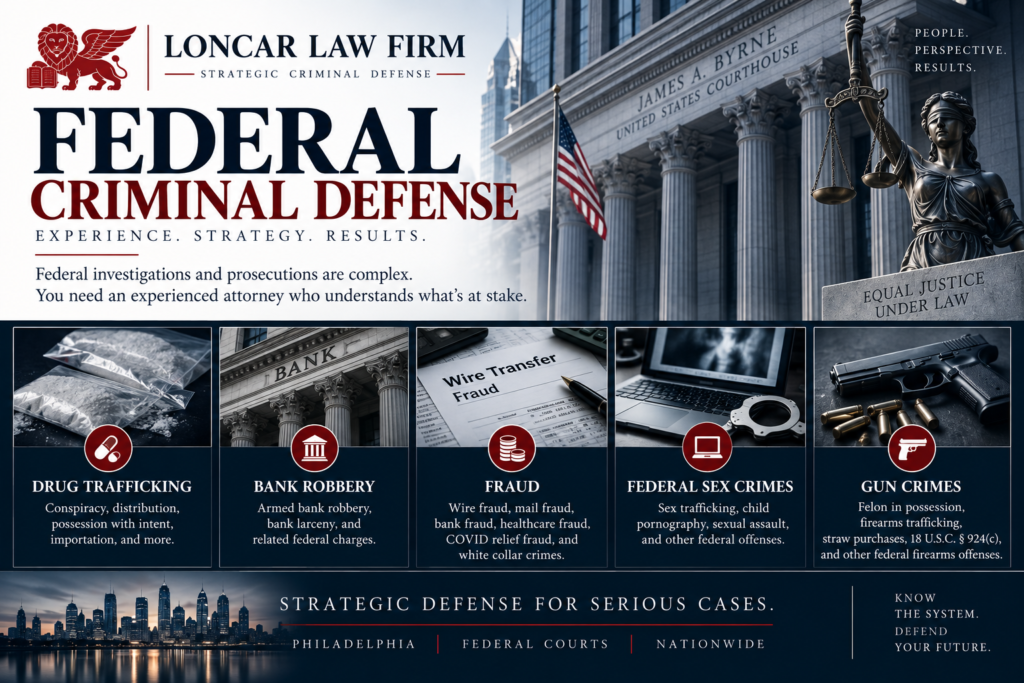
Drug trafficking and distribution (More on federal drug trafficking defense, More on importation of narcotics)
White-collar crimes (More on federal fraud crimes defense – Mail Fraud, Wire Fraud, Healthcare Fraud, Bank Fraud)
Firearms offenses (More on federal gun crimes)
Racketeering (RICO) (More on federal conspiracy and RICO cases)
Cybercrime and identity theft
Immigration offenses (illegal re-entry, alien smuggling)
Federal sex crimes (More on federal sex crimes laws)
While many of the above types of cases may be heard in state court if filed by local or state prosecutors, they are among the most common types of cases filed in federal court. These cases often involve extensive and detailed investigations and evidence gathering long before an arrest is made. Note that many of these charges can overlap. For example, a drug trafficking case will often include charges of conspiracy, weapons charges, money laundering, and more.
Why Federal Cases Are More Serious
Federal criminal cases are widely regarded as more severe than state cases for several reasons. First, federal investigators and prosecutors typically have substantial resources and tend to only pursue cases they believe they can win. Second, penalties are often harsher, including longer prison sentences, steep fines, and mandatory minimums for certain offenses. Some illustrations of how the federal government’s resources can impact the seriousness of a case include the means of collecting evidence, the amount of time the government can devote to a particular case, and the training and experience of both the law enforcement officers and prosecutors involved.
In Philadelphia, the U.S. Attorney’s Office for the Eastern District of Pennsylvania is one of the largest in the country, with specialized divisions dedicated to prosecuting complex crimes like conspiracy, drug crimes, embezzlement, weapons offenses, and fraud. This means defendants are often up against highly experienced prosecutors working closely with federal agents who are well trained and have a wealth of resources at their disposal.
The federal sentencing guidelines (discussed more below) give federal law enforcement officers and prosecutors more leverage during interrogations and plea negotiations. Ultimately, when suspects or defendants are facing more serious penalties and the evidence against them is stronger, defending the case requires that much more experience and skill.
The Federal Criminal Process
Federal cases follow a structured and often fast-moving process:
Investigation: Federal agencies may spend months or years building a case before charges are filed. Investigations can include complex surveillance, the use of confidential informants, search warrants (including search warrants for residences and other property, as well as search warrants for things like phone records, computer records, bank records, etc.). More about pre-indictment representation
Indictment and Complaint: Most federal charges are brought through a grand jury indictment. For cases involving detailed investigations, indictment will typically occur before arrest, but this is not always the case. In fast-moving investigations or caught-in-the-act scenarios, it is common for an arrest to happen first. In these cases, the government will file a criminal complaint at the time of arrest, and seek an indictment later.
Initial Appearance and Arraignment: An initial appearance is the first time a defendant is brought before the court. If arrested before being indicted, there will be a complaint briefly alleging the facts supporting the charges. After a defendant has been indicted, the Indictment will specifically list the charges the grand jury found there was enough evidence to charge. At an arraignment, a defendant is advised of the charges against them and enters a plea.
Detention: Defendants appear in court and may face detention pending trial. If a defendant is ordered detained at initial appearance, they are entitled to an appeal to the district court. Detention can be addressed at an initial appearance, at a detention hearing, or upon de novo review before the district court judge.
Discovery and Pretrial Motions: Evidence is exchanged, and legal challenges to the indictment, evidence, or other statutory and constitutional issues are raised.
Plea Negotiations or Trial: Most federal cases resolve through plea agreements, but some proceed to trial.
Sentencing: If convicted, sentencing is guided by federal sentencing guidelines and statutes. More about pretrial motions
Trial: Federal defendants are entitled to a jury trial on all offenses except petty offenses. In a federal trial, the parties have a limited opportunity to participate in jury selection, then the prosecution gives its opening statement, typically followed by the defense opening statement. After opening statements, the prosecution calls its witnesses to present its evidence. The defense may cross-examine the government’s witnesses. Next, the defense may call witnesses, but is not required to. Once both sides have “rested” the parties deliver their closing arguments. More information about the trial process
Plea: Most federal cases do not go to trial and are instead resolved with a guilty plea. This plea is often negotiated over time to secure a more favorable outcome than the defendant faces if convicted at trial. An agreement might provide for a specific sentence, or a range of available sentences, but will typically involve either a dismissal of some charges or an agreement regarding sentencing that is likely to result in a lesser sentence. If an agreement is reached, the defendant will sign a written plea agreement and enter a guilty plea at a change of plea hearing.
Sentencing: Whether convicted at trial or pursuant to a plea, a person who is convicted of a federal crime will go before the district court judge for sentencing. Prior to the imposition of a sentence, the Probation department will conduct what is called a pre-sentence investigation and prepare a pre-sentence report (“PSR”). The PSR will contain detailed information about a defendant’s background and the crime, and recommend a sentence. Both the prosecution and defense will prepare written sentencing memoranda for the judge to review prior to sentencing. A good sentencing memorandum can greatly impact the final sentence imposed. Finally, at the hearing, the attorneys are given an opportunity to argue, and the defendant gets a chance to speak.
Appeal: If convicted, a defendant may appeal his or her conviction or sentence. Note that most plea agreements will limit the issues which may be raised on appeal, but certain issues (ineffective assistance of counsel, prosecutorial misconduct) cannot be waived.
Because federal cases are complex and procedural rules are strict, early legal intervention by an experienced federal criminal defense attorney is essential. When facing federal charges in Philadelphia, it is imperative to have a skilled and experienced federal criminal defense lawyer on your side.
Federal Sentencing Guidelines and Mandatory Minimums (Detailed Explanation of Federal Sentencing)
One of the most challenging aspects of federal criminal defense is sentencing. Federal judges rely on the U.S. Sentencing Guidelines, which calculate a recommended sentencing range based on factors such as the severity of the offense and the defendant’s criminal history. Though the guidelines are now advisory, and judges are permitted to sentence outside the applicable guideline range, the law does require judges to consider the guideline range, and it serves as a de facto starting point in many sentencing hearings.
In addition, many federal crimes carry mandatory minimum sentences, particularly drug and firearm offenses. These laws limit judicial discretion and can result in lengthy prison terms. Unlike the advisory guidelines, mandatory minimums are generally mandatory. However, in some cases, mechanisms such as cooperation agreements or “safety valve” provisions may reduce exposure. Harsh mandatory minimums are one factor that gives the government an upper hand in negotiations, and can result in long sentences.
An experienced federal criminal defense attorney will focus on minimizing sentencing risks by challenging guideline calculations, disputing enhancements, and presenting mitigating evidence. Guiding a client throughout the pendency of the case, a skilled and experienced federal criminal defense lawyer can help to coordinate rehabilitative efforts that will pay dividends should the case proceed to sentencing.
Building a Strong Federal Defense
A successful federal defense requires a strategic and proactive approach. Unlike many state cases, federal prosecutions are typically well-prepared, making it essential for defense counsel to carefully analyze every aspect of the case.
Key federal criminal defense lawyer strategies may include:
Challenging the legality of searches and seizures under the Fourth Amendment
Disputing the credibility of witnesses or informants
Identifying weaknesses in the government’s evidence
Negotiating favorable plea agreements when appropriate
Preparing for trial when necessary
Because federal agencies often rely on tools such as wiretaps, surveillance, and confidential informants, there are multiple opportunities to challenge how evidence was obtained.
The Importance of Experienced Representation
Federal criminal defense is not an area for general practice attorneys. The rules, procedures, and stakes are entirely different from state court. As many Philadelphia defense firms emphasize, navigating federal court requires in-depth knowledge, meticulous preparation, and significant courtroom experience.
An experienced federal criminal defense lawyer can intervene early—sometimes even during the investigation phase—to protect your rights and potentially prevent charges from being filed. If charges are already pending, your attorney will guide you through every stage of the process, from arraignment to trial or sentencing.
Federal criminal charges in Philadelphia carry serious consequences, but they are not unbeatable. With the right legal strategy, it is possible to challenge the government’s case, reduce potential penalties, and protect your future. If you are facing a federal investigation or indictment, time is critical. The earlier you involve a skilled federal criminal defense attorney, the better your chances of achieving a favorable outcome.

Federal Drug Crimes Defense
Federal drug crimes are not the run-of-the-mill corner drug dealer cases that are often prosecuted in state courts. A federal drug case typically involves a complex investigation that aims to get higher up the ladder to the levels of importation, production, distribution, and trafficking. Often combined with conspiracy, money laundering, and weapons offenses, federal drug crime prosecutions are very serious. more
Federal Weapons Offenses
Common federal weapons offenses include felon in possession of a firearm, weapons trafficking, straw purchases, and possession of a firearm during the commission of a crime of violence. Often targeting individuals with prior criminal records, sentencing guidelines often call for very harsh penalties. A thorough and tactical defense approach can make a big difference. In particular, motions to suppress unlawful searches and seizures can sometimes result in the complete dismissal of a firearms offense. more
Federal Fraud Crimes Defense
Fraud offenses often invoke federal law through the use of the mail, financial institution wire transfers, and federal funding for things like healthcare and education benefits. Fraud investigators can gain access to a wide range of financial records, and then work to try to connect the dots with statements from suspects. Typically involving voluminous discovery, fraud case defense requires a thorough and experienced defense. Persuasive ability, while important, comes second to truly understanding financial transactions and record keeping. more
Federal Sex Crimes Defense
Federal sex crimes can involve travel across state lines and to foreign countries, the possession, distribution, or production of child pornography, aggravated sexual abuse, sexual abuse of a child, and sex trafficking. Federal sex crimes carry very high potential sentences, including both high guideline ranges and mandatory minimums. Even the most skilled and experienced federal criminal defense attorneys face an uphill battle with sex offenses; prosecutors, jurors, and judges often harbor strong feelings about these charges. Defending federal sex crimes requires great technical legal proficiency, as well as the ability to advocate in a way that overcomes these hurdles. more
Federal Sentencing
Although avoiding a conviction is ideal, achieving the best result in a case often involves working hard to achieve the best possible sentence. Effective advocacy for sentencing goes far beyond the sentencing guidelines and submitting character letters. Click here for a thorough explanation of the federal sentencing process
Contact a Philadelphia Federal Criminal Defense Attorney now to schedule a consultation.