
Philadelphia Federal Fraud Crimes Defense Attorney
Passionate, Aggressive, and Experienced Criminal Defense in Serious Fraud Cases
Federal Wire Fraud
Federal Mail Fraud
Federal Bank Fraud
Federal Healthcare Fraud
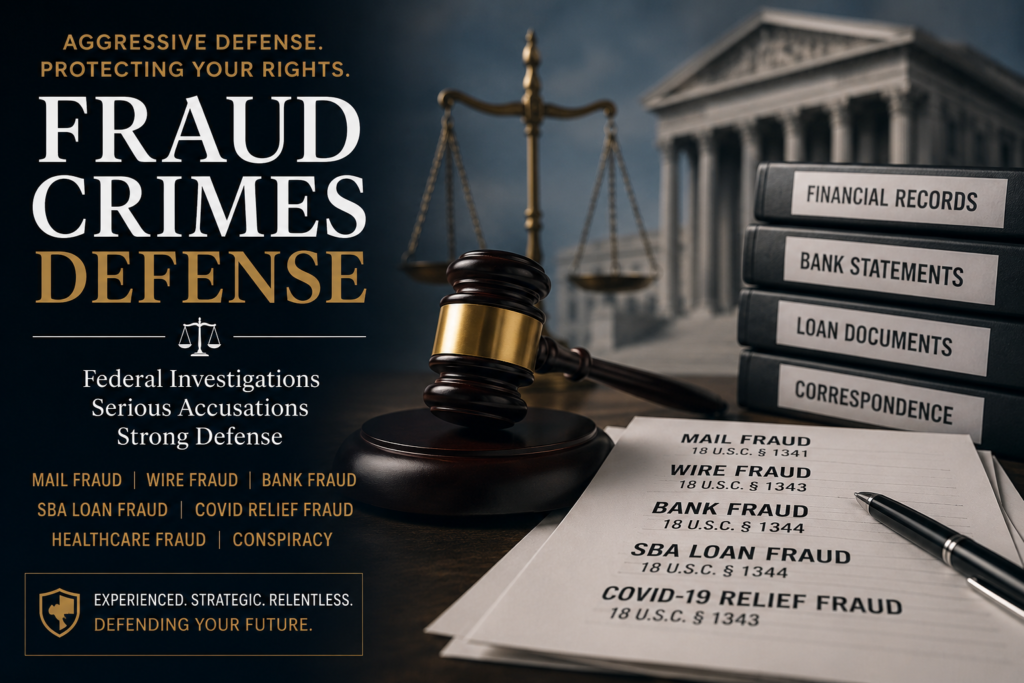
Federal fraud investigations are among the most complex cases prosecuted in the federal system, and are prosecuted aggressively. Common allegations involve financial transactions to accusations of mail fraud, wire fraud, healthcare fraud, securities fraud, fraud against the federal government, false statements, or conspiracy. Federal prosecutors and agencies often devote enormous resources to building these cases over time, long before charges are filed. If you are under investigation or have been charged with a federal fraud offense in Philadelphia, securing experienced legal representation as early as possible is very important. Hiring a federal fraud defense lawyer early can make a critical difference in the outcome of your case.
Federal fraud crimes are prosecuted under a wide range of statutes. Some of the most commonly charged offenses are mail fraud under 18 U.S.C. § 1341 and wire fraud under 18 U.S.C. § 1343, and bank fraud under 18 U.S.C. § 1344. These statutes broadly prohibit schemes to obtain money or property through false or fraudulent pretenses using the mail, telephone systems, email communications, interstate wire transmissions, or electronic financial transactions. Because nearly all modern business and banking activity involves electronic communication, federal prosecutors frequently rely on wire fraud statutes in white collar investigations. Congress derives its power to legislate most federal crimes on the basis of interstate or foreign commerce, which is generally going to be implicated with use of financial institutions, US mail, and even the internet.
More information about: Mail Fraud | Wire Fraud | Healthcare Fraud | Bank Fraud | Philadelphia White Collar Crimes Defense
Related to these enumerated fraud statutes, federal authorities also aggressively prosecute conspiracy offenses under 18 U.S.C. § 371, money laundering under 18 U.S.C. §§ 1956 and 1957, and aggravated identity theft under 18 U.S.C. § 1028A. In recent years, the federal government has dramatically increased enforcement efforts involving COVID-19 relief fraud, Paycheck Protection Program (PPP) fraud, Economic Injury Disaster Loan (EIDL) fraud, and Small Business Administration (SBA) loan fraud allegations. These investigations frequently involve accusations that individuals or businesses submitted inaccurate information in order to obtain pandemic-related relief funds. During the COVID-19 pandemic, government programs sought to keep the economy going with less oversight on the front end of disbursement of funds, but now agencies are looking for repayment, often by accusing beneficiaries of fraud.
While the statute of limitations (the time from the commission of a crime that the government has to file criminal charges) for most federal crimes is 5 years, fraud crimes affecting financial institutions can be filed up to 10 years following the commission of the crime. Additionally, major fraud against the United States carries a 7 year statute of limitation. Unlike many state statutes, the statute of limitations begins to run at the time of commission of the offense (the act), instead of upon discovery of the offense. Offenses can, however, take place over time and be considered part of a continuing offense.
COVID relief fraud investigations have become a major priority for the Department of Justice, the FBI, the SBA Office of Inspector General, IRS Criminal Investigations, and other federal agencies. Prosecutors often allege that loan applications overstated or falsified payroll expenses, exaggerated business revenues, misstated employee counts, or improperly used relief funds after disbursement. However, many of these programs were implemented quickly during a national emergency, often with changing guidance and confusing eligibility requirements. In some situations, prosecutors may oversimplify complicated business records or mistake negligence, bookkeeping errors, or misunderstandings for criminal conduct.
Federal fraud cases are often heavily document-driven and financially complex. Investigators may review bank records, tax returns, business ledgers, emails, text messages, loan applications, accounting files, and electronic communications spanning many years. Federal agencies frequently use subpoenas, search warrants, forensic accounting reviews, and witness interviews to build their cases. By the time charges are filed, prosecutors may already have assembled extensive documentation and a detailed narrative of the alleged scheme.
However, federal investigations are not infallible. Prosecutors still carry the burden of proving guilt beyond a reasonable doubt, including proving that the accused knowingly and intentionally participated in a fraudulent scheme. In many fraud cases, the central issue is intent. The government may attempt to portray ordinary business disputes, accounting discrepancies, failed investments, or poor financial decisions as evidence of fraud. A strong defense often involves challenging whether the government can actually prove deliberate criminal intent rather than mistake, misunderstanding, or reliance on inaccurate information provided by others.
Even in cases with strong evidence of fraud, there may be a question of who is responsible. Complex and sophisticated fraud schemes often aim to protect the actual perpetrator from detection. A scheme capable of defrauding a financial institution or federal agency can also be designed to make it appear as though someone else is to blame. Defending against fraud charges might not always entail seeking to deny that fraud took place, but might rather focus on mistaken identity, a lack of fraudulent intent, or a general lack of evidence to meet the government’s heavy burden.
An experienced federal criminal defense attorney will carefully examine every aspect of the government’s case. This includes reviewing search warrants, subpoena returns, financial analyses, witness statements, electronic communications, and investigative reports prepared by federal agents. In some cases, investigators may have relied on unreliable witnesses, incomplete records, misleading summaries, or assumptions that fail to account for the realities of business operations. Defense counsel may also challenge whether federal investigators violated constitutional protections during the investigation, including unlawful searches, improper interrogations, or overbroad seizure warrants.
Early intervention can be especially important in federal fraud investigations. Many individuals first discover they are under investigation when federal agents attempt to conduct interviews or serve subpoenas for financial records. Speaking to investigators without legal representation can create serious risks. Even seemingly harmless statements may later be used to support allegations regarding intent or false statements to federal agents under 18 U.S.C. § 1001. Having an attorney involved early in the investigation can help protect your rights and avoid unnecessary exposure.
Federal sentencing in fraud cases can also be severe. Under the Federal Sentencing Guidelines, factors such as alleged loss amounts, number of victims, use of sophisticated means, leadership roles, abuse of trust, or identity theft allegations can substantially increase sentencing exposure. Prosecutors frequently seek inflated loss calculations that may not accurately reflect actual damages or personal gain. Effective federal defense representation often includes aggressively challenging these sentencing enhancements and presenting mitigating evidence regarding the client’s background, conduct, and intent.
Federal fraud cases in Philadelphia are generally prosecuted in the United States District Court for the Eastern District of Pennsylvania. Federal court litigation differs significantly from state criminal proceedings and requires extensive knowledge of federal procedure, evidentiary rules, and sentencing practices. Successfully defending these cases requires strategic preparation, detailed financial analysis, and aggressive advocacy at every stage of the case.
If you are facing allegations involving mail fraud, wire fraud, SBA loan fraud, PPP fraud, healthcare fraud, or any other federal white collar offense in Philadelphia, it is critical to seek experienced legal representation immediately. An accusation is not a conviction. A skilled and experienced Philadelphia federal criminal defense lawyer can evaluate the government’s evidence, protect your constitutional rights, and build a strong defense tailored to the specific facts of your case.
CALL FOR A FREE CONSULTATION (215) 267-0500
Philadelphia Federal Criminal Defense Attorney | Philadelphia Criminal Defense Lawyer | Loncar Law Firm Practice Areas