
Federal Gun Crimes Defense
Philadelphia Criminal Defense Lawyer
Federal Gun Crimes Lawyer in Philadelphia
Federal firearm charges are aggressively prosecuted and harshly punished in the federal criminal justice system. Federal prosecutors often pursue gun-related offenses alongside allegations involving narcotics trafficking, robbery, violent crime, fraud, or organized criminal activity. Because many federal firearm statutes impose mandatory minimum prison sentences and sentencing enhancements, individuals accused of federal gun crimes should seek immediate representation from an experienced Philadelphia federal gun crimes lawyer.
Federal gun crime investigations are commonly conducted by agencies such as the ATF, FBI, DEA, Homeland Security Investigations, and local federal task forces. These investigations frequently involve search warrants, confidential informants, wiretaps, surveillance, forensic analysis, and social media evidence. Philadelphia federal firearm prosecutions often arise from investigations involving alleged drug trafficking organizations, straw purchasing/trafficking schemes, prohibited persons possessing firearms, and crimes of violence involving weapons.
One of the most commonly charged federal firearm offenses is felon in possession of a firearm under 18 U.S.C. § 922(g). This law prohibits certain individuals from possessing firearms or ammunition, including convicted felons, unlawful drug users, individuals convicted of certain domestic violence offenses, and others prohibited under federal law. Prosecutors must generally prove that the defendant knowingly possessed a firearm and that the firearm traveled in interstate commerce, which is often relatively easy for the government to establish because most firearms are manufactured outside Pennsylvania.
Possession in these cases may be actual or constructive. Constructive possession means the government alleges that a person exercised control over a firearm even if it was not physically on their person. Firearms discovered in vehicles, residences, or shared locations frequently become the basis for constructive possession allegations. Defense lawyers often challenge whether the defendant actually knew about the firearm or had the ability and intent to control it.
Federal firearm trafficking investigations are also increasingly common. Under federal law, firearm trafficking allegations often involve accusations that individuals unlawfully purchased, transported, or distributed firearms knowing they would be used illegally or transferred to prohibited persons. These cases may involve allegations of interstate firearm movement, gang-related activity, narcotics trafficking organizations, or firearms recovered at crime scenes.
Closely related are federal straw purchase allegations. A straw purchase occurs when one person buys a firearm on behalf of another person while falsely representing themselves as the actual buyer during the federal firearm transaction process. These cases are commonly prosecuted under 18 U.S.C. §§ 922(a)(6) and 924(a)(1)(A). Federal prosecutors often pursue straw purchase cases aggressively when firearms later become connected to violent crimes or trafficking investigations. In many situations, individuals may not fully understand the seriousness of acting as a “buyer” for another person until they are facing federal charges.
Another extremely serious federal firearm statute is 18 U.S.C. § 924(c), which criminalizes possessing, using, carrying, or brandishing a firearm during and in relation to a crime of violence or drug trafficking crime. Section 924(c) charges are particularly dangerous because they carry mandatory consecutive prison sentences that must run in addition to any sentence imposed for the underlying offense.
Depending on the allegations, a § 924(c) conviction may result in mandatory minimum sentences of five years, seven years for brandishing, or ten years for discharging a firearm. Certain firearm types, such as short-barreled rifles, machine guns, or destructive devices, can trigger even harsher penalties. Prosecutors frequently use § 924(c) charges in federal robbery, carjacking, narcotics conspiracy, and violent crime prosecutions in Philadelphia federal court. For crimes of violence caught on video, the use of a firearm might also leave open defenses. The government must prove that a firearm is real (i.e. not a replica), and that it traveled in interstate commerce; this can be difficult if agents did not recover an actual weapon, and if no one fired the alleged weapon.
Federal firearm defendants may also face enhanced sentencing under the Armed Career Criminal Act (“ACCA”), codified at 18 U.S.C. § 924(e). The ACCA applies when a defendant charged under § 922(g) has three qualifying prior convictions for violent felonies or serious drug offenses committed on separate occasions. If applicable, the ACCA imposes a mandatory minimum sentence of fifteen years in federal prison.
Whether prior convictions qualify under the ACCA is often heavily litigated. Federal courts frequently analyze prior Pennsylvania convictions to determine whether they meet the statutory definitions of “violent felony” or “serious drug offense.” Supreme Court decisions over the years have significantly narrowed portions of the ACCA, leading to complex legal disputes over predicate offenses and sentencing enhancements. An experienced federal defense attorney carefully reviews prior convictions, sentencing records, and applicable case law to challenge improper ACCA enhancements whenever possible.
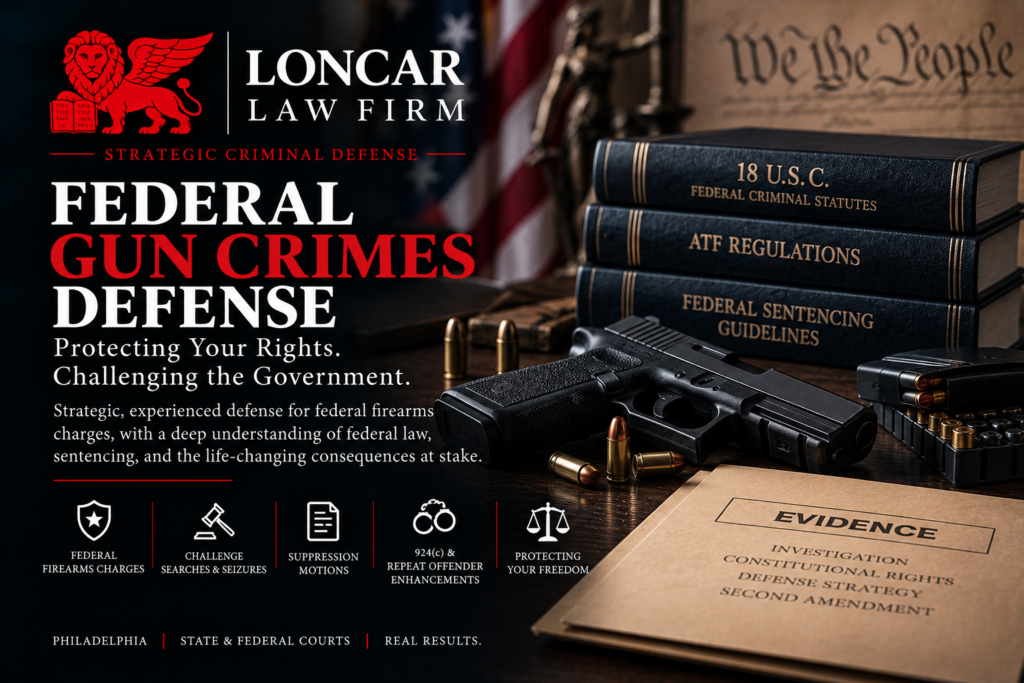
Federal gun crime defense often centers on constitutional and evidentiary challenges. Defense lawyers may challenge unlawful traffic stops, vehicle searches, search warrants, interrogations, cellphone searches, or alleged Fourth Amendment violations. Suppression motions can be critical in cases where law enforcement improperly obtained firearms or statements from defendants.
In many federal firearm cases, prosecutors rely heavily on cooperating witnesses, forensic evidence, text messages, recorded communications, and social media posts. A skilled defense attorney carefully examines the reliability and admissibility of this evidence while identifying inconsistencies and weaknesses in the government’s case. Having an attorney familiar with firearm laws, constitutional law, as well as firearms themselves is essential.
Federal firearm charges can expose defendants to devastating consequences, including lengthy prison sentences, mandatory minimum penalties, supervised release, and permanent loss of firearm rights. Early intervention by an experienced Philadelphia federal criminal defense lawyer can be critical to protecting constitutional rights, challenging the government’s evidence, negotiating with prosecutors, and pursuing the best possible outcome in federal court.
RELATED PAGES: PA State Court Guns Crimes, Philadelphia Violent Crimes Lawyer, Federal Criminal Defense Lawyer, Philadelphia Murder and Homicide Lawyer
Motion to Suppress Evidence Issues
Unlawful Traffic Stop, Unlawful Stop and Frisk, Unlawful Search of Vehicle
Overbroad Warrant, Warrant Lacks Probable Cause, Geofence Warrant
Outside Scope of Warrant, Warrantless Search of Home or Business
Coerced or Falsified Consent, Outside Scope of Consent
USEFUL LINKS: Federal Firearm Rights Restoration DOJ Page, ATF – Philadelphia, Loncar Law Firm Practice Areas, Federal Criminal Defense Overview