
Pre-Indictment Representation
Philadelphia Criminal Defense Attorney
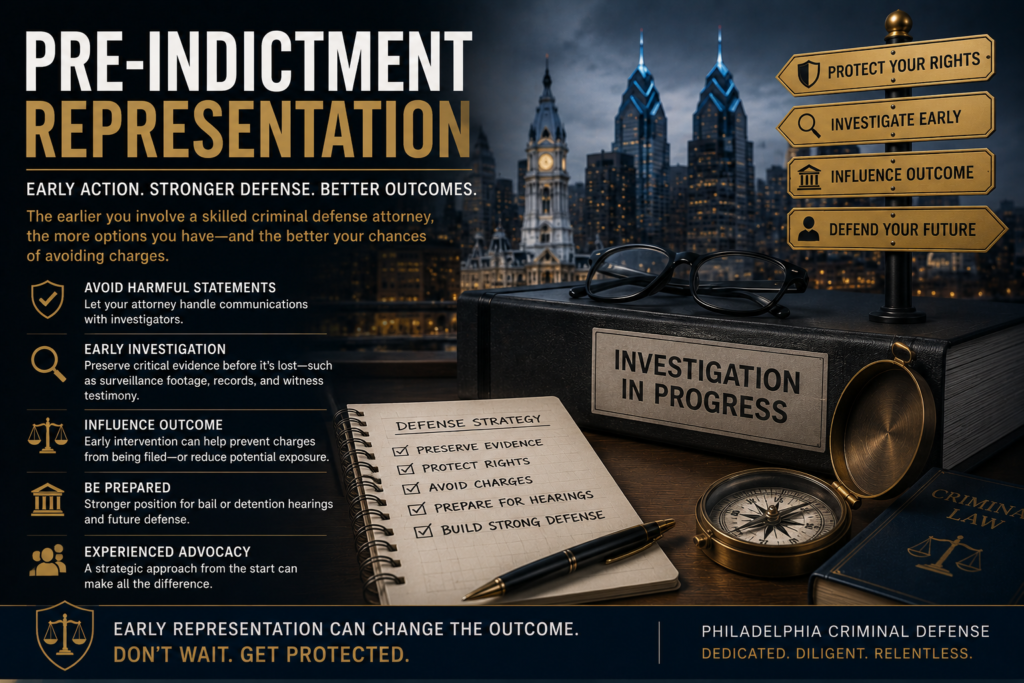
Pre-Indictment Representation: Why Early Intervention Can Make a Critical Difference
Many people assume they need a criminal defense attorney only after they have been arrested, charged, or indicted. In reality, some of the most important work a defense lawyer can do occurs before formal charges are ever filed, during pre-indictment representation. Whether the investigation involves federal offenses, white-collar crimes, drug trafficking allegations, fraud, public corruption, firearms offenses, or other serious criminal matters, pre-indictment representation can significantly improve a person’s position and, in some cases, prevent charges from being filed altogether.
In cases where a suspect becomes aware of the investigation against them prior to arrest or indictment, it may be very beneficial to engage the services of an experienced Philadelphia criminal defense attorney. This can be true in both federal and state investigations, as well as investigations involving joint task forces.
While no attorney can guarantee that an investigation will end without criminal charges, early intervention by an experienced criminal defense lawyer often provides substantial advantages that may not be available after an indictment or arrest occurs. The earlier a defense attorney becomes involved, the more opportunities there may be to protect the client’s rights, preserve favorable evidence, influence charging decisions, and prepare for future litigation.
What Is Pre-Indictment Representation?
Pre-indictment representation refers to legal representation during the early, investigative phase of a criminal case, before formal charges have been filed.
In many investigations, individuals first learn they are under scrutiny when:
- Federal agents request an interview;
- Investigators contact family members, employers, or business associates;
- A search warrant is executed;
- A grand jury subpoena is served;
- Bank records or business records are requested;
- Law enforcement seeks consent to search property or electronic devices.
At this stage, prosecutors and investigators are still gathering evidence and making decisions about whether criminal charges should be filed and, if so, what charges may be appropriate.
This period can be one of the most important stages of the entire case.
Avoiding Harmful Statements to Investigators
One of the most immediate benefits of pre-indictment representation is protecting clients from making statements that may later be used against them.
Many individuals believe they can “clear things up” by voluntarily speaking with investigators. Unfortunately, even truthful statements can create significant problems if they are misunderstood, mischaracterized, incomplete, or contradicted by other evidence.
Federal agents and investigators are trained interviewers. Information obtained during interviews may later become evidence at trial, form the basis of obstruction allegations, or be used to challenge a defendant’s credibility.
In some situations, investigators already possess substantial evidence and may simply be seeking admissions that strengthen the prosecution’s case.
An experienced criminal defense attorney can communicate with investigators on behalf of the client, evaluate whether cooperation is advisable, and help ensure that constitutional rights are protected throughout the investigation.
The Possibility of Preventing Charges
One of the primary goals of pre-indictment representation is to persuade prosecutors that criminal charges should not be filed.
Although this outcome is not always possible, there are circumstances where defense counsel may be able to:
- Present exculpatory evidence;
- Correct factual misunderstandings;
- Provide innocent explanations for suspicious conduct;
- Demonstrate weaknesses in the government’s evidence;
- Identify credibility problems with witnesses;
- Highlight legal deficiencies in the investigation.
In federal cases particularly, prosecutors often spend months or even years investigating before seeking an indictment. During that time, skilled defense counsel may have opportunities to present information that influences charging decisions.
Even when charges ultimately cannot be avoided, early advocacy may help narrow the scope of allegations or reduce the severity of potential charges.
Conducting an Early Defense Investigation
Perhaps the greatest advantage of pre-indictment representation is the ability to begin the defense investigation immediately.
Law enforcement agencies typically begin collecting evidence as soon as they suspect criminal activity. Defense attorneys should be doing the same.
Critical evidence often disappears long before a case reaches an indictment or preliminary hearing. Surveillance footage may be overwritten within days or weeks. Witness memories fade. Digital records can be lost. Businesses close. Phones are replaced. Social media accounts disappear.
By becoming involved early, a defense attorney may be able to obtain and preserve evidence that otherwise would be unavailable by the time formal charges are filed.
Examples of valuable evidence that may disappear include:
- Surveillance video;
- Security camera footage;
- Cell phone data;
- GPS records;
- Text messages;
- Social media content;
- Business records;
- Witness statements.
In many cases, evidence gathered during the early stages of an investigation becomes some of the most important evidence presented at trial.
Preserving Witness Testimony
Witnesses are often most reliable shortly after an event occurs. As time passes, memories fade and details become less clear.
Early defense investigation allows counsel to identify witnesses, obtain statements, and preserve testimony before memories deteriorate or witnesses become unavailable.
This can be particularly important in cases involving:
- Alleged conspiracies;
- Drug investigations;
- Financial crimes;
- Violent offenses;
- White-collar investigations.
In some situations, witnesses favorable to the defense may relocate, become difficult to locate, or forget important details by the time charges are filed.
Better Preparation for Arrest, Bail, and Detention Hearings
Another significant advantage of pre-indictment representation is preparation.
Many defendants first begin preparing their defense only after an arrest occurs. By that point, prosecutors may already have months or years of investigative work completed. The early stage of a case can move quickly, and giving your attorney an opportunity to conduct background investigation and other preparations is imperative.
A client represented during the investigative stage enters the next phase of the case with a substantial head start.
If charges are ultimately filed, defense counsel may already have:
- Investigated the allegations;
- Reviewed available evidence;
- Identified favorable witnesses;
- Developed legal defenses;
- Gathered mitigation evidence;
- Prepared a strategy for release from custody.
This preparation can be particularly important in federal cases, where detention hearings frequently occur within days of arrest.
A defendant who has worked with counsel before charges are filed is often in a far stronger position to argue for pretrial release. Having already worked on gathering evidence supporting release will strengthen a challenge government requests for pretrial detention.
Strategic Advantages Throughout the Case
Early representation does more than protect a client during the investigation. It often improves the defense throughout every subsequent stage of the case.
The defense may be better positioned to:
- Challenge search warrants;
- Litigate suppression issues;
- Evaluate forensic evidence;
- Negotiate with prosecutors;
- Prepare for trial;
- Develop mitigation strategies for sentencing if necessary.
By the time an indictment is returned, the defense may already possess valuable information and evidence that would otherwise take months to develop.
The Importance of Experienced Counsel
Pre-indictment investigations are often complex, high-stakes matters involving prosecutors, law enforcement agencies, grand juries, and sophisticated investigative techniques. Decisions made during this stage can shape the outcome of the entire case. An important aspect of this early stage is that the defense is not entitled to discovery from the government until charges are filed. This means working to determine what the government knows and what the best steps are without providing additional evidence to the government during their investigation.
While avoiding criminal charges is often the primary goal, that result is not always possible. Even when charges are ultimately filed, early intervention by an experienced criminal defense attorney can provide enormous advantages, including preserving evidence, protecting constitutional rights, improving bail outcomes, identifying defenses, and preparing for the challenges ahead.
For individuals who believe they may be under investigation, waiting for an arrest or indictment is rarely the best strategy. Early representation can be one of the most important investments in protecting both freedom and future opportunities. If you believe that you may benefit from early stage representation in a criminal matter, contact the Loncar Law Firm for a free and confidential consultation with a Philadelphia criminal defense lawyer.
Call to schedule your consultation today. (215) 267-0500