Voluntary Manslaughter in Philadelphia
Philadelphia Criminal Defense Lawyer

Voluntary Manslaughter Law
Voluntary manslaughter is a lesser offense in murder cases that often arises in emotionally charged or rapidly unfolding situations involving provocation, sudden confrontations, or imperfect claims of self-defense. Although voluntary manslaughter is classified separately from murder under Pennsylvania law, convictions still carry severe prison exposure and life-changing consequences. In Philadelphia, prosecutors frequently charge murder offenses first and then further litigation determines whether the facts support reduction to voluntary manslaughter based on provocation or imperfect self-defense. Anyone accused of homicide-related offenses should immediately seek representation from an experienced Philadelphia homicide defense attorney.
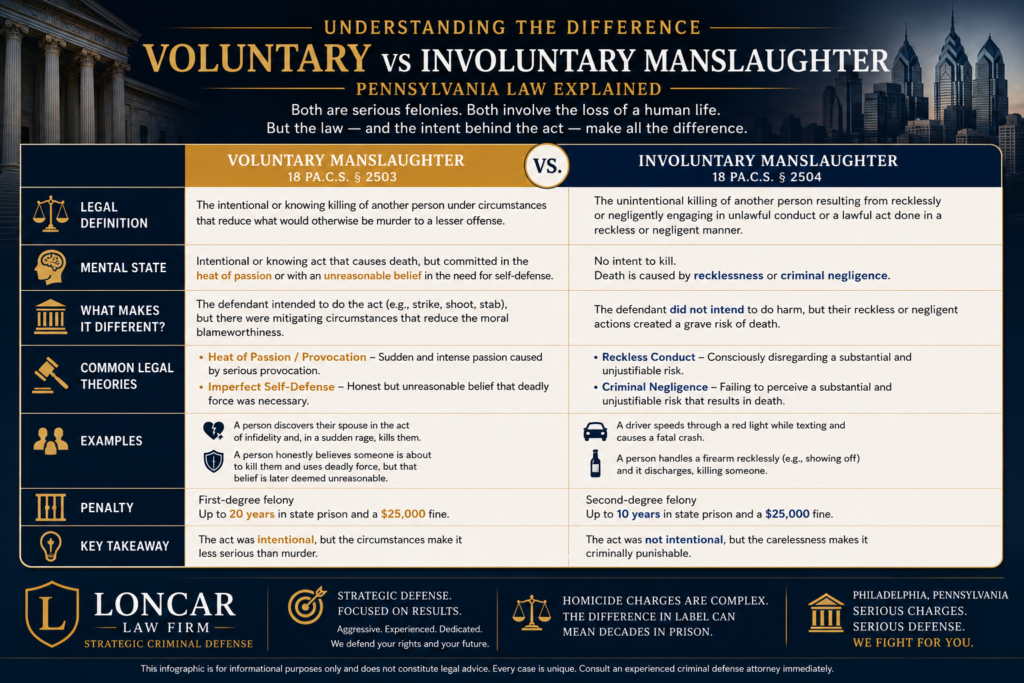
Pennsylvania voluntary manslaughter law is governed by 18 Pa.C.S. § 2503. The statute recognizes two primary forms of voluntary manslaughter: killings committed under sudden and intense passion resulting from serious provocation, and killings committed under an unreasonable belief that deadly force was justified. While still a serious crime, a conviction for voluntary manslaughter is significantly better than a conviction for murder.
Unlike first-degree murder, voluntary manslaughter does not require proof of a willful, deliberate, and premeditated killing. Unlike third-degree murder, voluntary manslaughter generally involves circumstances reducing moral blameworthiness because the killing occurred during extreme emotional disturbance or under an honestly held but legally unreasonable belief in the need for self-defense. In other words the voluntary act of killing someone does not rise to the level of murder because the intent and malice are mitigated by the the specific circumstances.
One form of voluntary manslaughter involves what is commonly referred to as a “heat of passion” or provocation killing. Under 18 Pa.C.S. § 2503(a), a person may be guilty of voluntary manslaughter if they intentionally or knowingly kill another person while acting under a sudden and intense passion resulting from serious provocation by the victim or another individual whom the defendant attempts to kill but mistakenly kills someone else instead.
Pennsylvania law recognizes that certain situations may provoke such intense emotional reactions that the offense should be treated differently from murder. However, not every angry or emotional reaction qualifies as adequate provocation. Courts generally examine whether the provocation was sufficiently serious to cause a reasonable person to lose self-control and whether the defendant acted before having sufficient time to cool off.
Examples of provocation-based voluntary manslaughter may include discovering a spouse during an act of infidelity, violent physical confrontations escalating suddenly, severe assaults, or emotionally explosive altercations where prosecutors concede the defendant acted in the heat of passion rather than with premeditated intent.
For example, prosecutors may initially charge first-degree murder where an individual fatally shoots another person during a violent domestic confrontation. However, the defense may argue the killing occurred immediately after serious provocation and under sudden intense passion, and a jury finding voluntary manslaughter appropriate rather than murder.
Another form of voluntary manslaughter arises through what Pennsylvania courts commonly refer to as “imperfect self-defense.” Under 18 Pa.C.S. § 2503(b), a person may be guilty of voluntary manslaughter if they intentionally or knowingly kill another person while honestly believing the killing was justified under self-defense principles, but that belief was unreasonable under the circumstances.
This doctrine is closely connected to Pennsylvania self-defense law. In a perfect self-defense case, a defendant may be fully acquitted if they reasonably believed deadly force was immediately necessary to protect themselves against death, serious bodily injury, kidnapping, or sexual assault. However, when the belief was genuine but legally unreasonable, prosecutors may argue that the offense should be treated as voluntary manslaughter rather than murder.
For example, imagine a person involved in a chaotic street confrontation who believes another individual is reaching for a firearm. If the accused shoots first based on an honest but mistaken interpretation of the threat, prosecutors may dispute whether the belief was objectively reasonable. In such circumstances, the defense may argue imperfect self-defense applies, reducing the offense from murder to voluntary manslaughter.
Voluntary manslaughter charges frequently arise as part of broader homicide litigation in Philadelphia courts. Prosecutors often charge first-degree or third-degree murder initially, while defense attorneys argue the facts support reduction to manslaughter based on provocation, emotional disturbance, or imperfect self-defense.
The distinction between murder and voluntary manslaughter can dramatically affect sentencing exposure. Voluntary manslaughter is generally graded as a first-degree felony in Pennsylvania and carries a maximum possible sentence of up to twenty years imprisonment. While still extremely serious, this penalty is substantially lower than the life imprisonment exposure associated with first-degree or second-degree murder convictions.
Pennsylvania sentencing courts consider numerous factors in voluntary manslaughter cases, including prior criminal history, the circumstances surrounding the offense, acceptance of responsibility, mental health issues, emotional disturbance, and mitigating evidence presented by the defense. In some cases, sentencing litigation becomes critically important in minimizing incarceration exposure.
Voluntary manslaughter prosecutions often involve complicated factual and forensic disputes. Prosecutors may rely heavily on witness testimony, surveillance footage, cellphone evidence, ballistics testing, blood spatter analysis, DNA evidence, autopsy findings, and statements allegedly made by the accused. A strategic homicide defense requires careful review of every aspect of the government’s case.
Self-defense remains one of the most important issues in voluntary manslaughter litigation. In many cases, defense attorneys argue that the accused acted lawfully and should be completely acquitted under Pennsylvania’s self-defense statute. Even where prosecutors reject full self-defense claims, evidence supporting fear, panic, or perceived threats may significantly strengthen arguments for voluntary manslaughter rather than murder.
Defense attorneys also frequently challenge witness credibility, forensic conclusions, and police investigative methods. Mistaken witness accounts, unreliable identifications, incomplete forensic analysis, or improperly interpreted physical evidence may create reasonable doubt regarding the prosecution’s version of events.
Constitutional litigation also plays a major role in homicide defense. Defense attorneys often file motions seeking suppression of statements obtained in violation of Miranda rights, exclusion of unlawfully seized evidence, or suppression of evidence obtained through unconstitutional searches and seizures. In homicide prosecutions, statements made during police interrogations frequently become central evidence at trial.
Because homicide allegations carry extraordinarily serious consequences, early intervention by an experienced Philadelphia criminal defense attorney is critical. A lawyer focused on strategic defense and serious violent crime representation can aggressively investigate the facts, challenge forensic evidence, litigate suppression issues, negotiate strategically with prosecutors, and prepare thoroughly for trial.
Homicide cases where voluntary manslaughter may apply are often highly nuanced and emotionally complex. Whether the allegations involve heat of passion, imperfect self-defense, or disputed homicide charges, a strong and strategic defense can make a critical difference in both the outcome of the case and the future of the accused.
Serving Philadelphia and surrounding counties. Licensed throughout Pennsylvania, Arizona, California, and Texas.
Call for a free and confidential consultation (215) 267-0500
RELATED PAGES: Philadelphia Homicide Defense Lawyer, Philadelphia First Degree Murder Defense, Second Degree Murder, Third Degree Murder, Involuntary Manslaughter