
Involuntary Manslaughter Defense Attorney
Philadelphia Homicide Defense Lawyer
orney
Pennsylvania Involuntary Manslaughter Laws
Being charged with causing another person’s death is one of the most serious situations a person can face in the criminal justice system. In Pennsylvania, involuntary manslaughter is a homicide offense that applies when a death allegedly results from reckless or grossly negligent conduct, even if there was no intent to kill. Although involuntary manslaughter is considered less severe than murder or voluntary manslaughter, a conviction can still lead to incarceration, a permanent criminal record, loss of professional licenses, and devastating personal consequences.
An experienced Philadelphia criminal defense attorney can investigate the circumstances surrounding the incident, challenge the prosecution’s evidence, and work to protect the accused from unfair or excessive punishment.
What Is Involuntary Manslaughter in Pennsylvania?
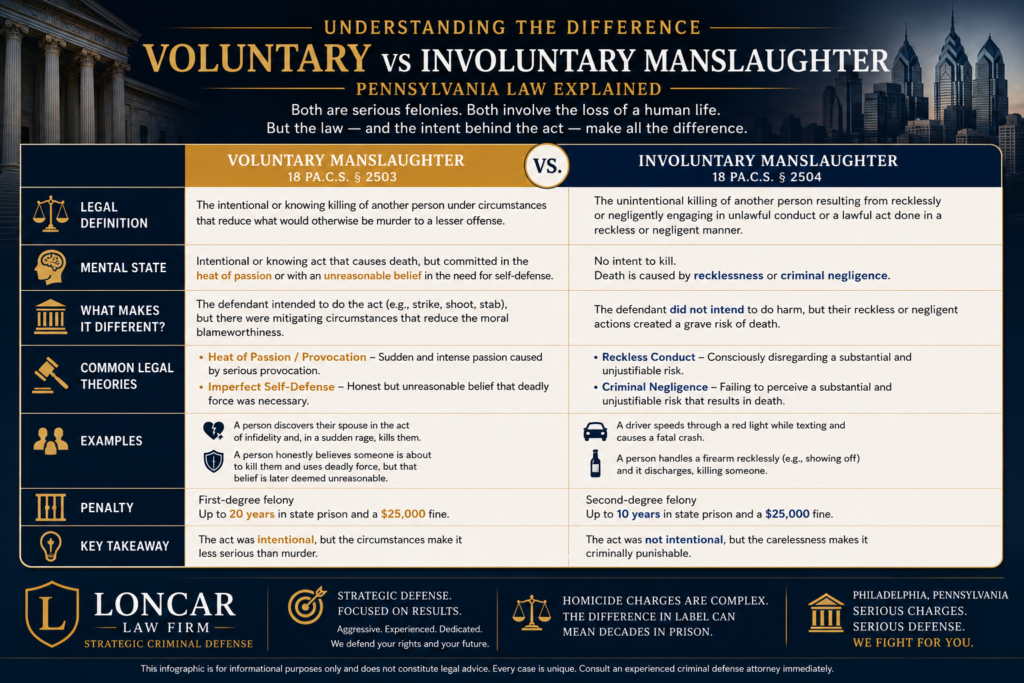
Pennsylvania’s involuntary manslaughter law is found at 18 Pa. C.S. § 2504. Under the statute, a person may be guilty of involuntary manslaughter when, “as a direct result of doing an unlawful act in a reckless or grossly negligent manner, or the doing of a lawful act in a reckless or grossly negligent manner, causes the death of another person.”
In Pennsylvania, the punishment for an involuntary manslaughter conviction depends on the circumstances of the case and whether certain aggravating factors apply.
Under 18 Pa. C.S. § 2504, involuntary manslaughter is generally classified as a first-degree misdemeanor. A conviction for a first-degree misdemeanor carries a maximum sentence of:
- Up to 5 years in prison
- A fine of up to $10,000
- Probation, parole supervision, restitution, and other court-imposed conditions
However, the offense can be elevated to a second-degree felony in certain situations. Most commonly, this occurs when the victim is under the age of 12 and the defendant is over 18 years old and responsible for the child’s welfare, or in certain cases involving violations of laws designed to protect children.
A second-degree felony in Pennsylvania carries substantially more severe penalties, including:
- Up to 10 years in prison
- A fine of up to $25,000
In addition to incarceration, a conviction can result in significant collateral consequences, including:
- Loss of firearm rights
- Immigration consequences for non-citizens
- Damage to professional licenses and employment opportunities
- Civil wrongful death lawsuits
- Long-term probation or supervision requirements
The sentence imposed in any particular case can vary widely depending on factors such as:
- The defendant’s prior criminal record
- Whether drugs or alcohol were involved
- The level of alleged recklessness
- Whether a motor vehicle was involved
- The vulnerability of the victim
- Acceptance of responsibility or remorse
- Mitigating personal circumstances
Pennsylvania sentencing guidelines also influence the likely sentence range. In many cases involving little or no prior criminal history, experienced defense counsel may be able to pursue alternatives to lengthy incarceration, including probationary sentences, reduced charges, or diversionary resolutions where appropriate.
Related charges can also dramatically affect exposure. Prosecutors sometimes charge involuntary manslaughter alongside offenses such as:
- DUI
- Recklessly Endangering Another Person (REAP)
- Drug Delivery Resulting in Death
- Homicide by Vehicle
Because these cases often involve complicated factual and forensic issues, early intervention by a skilled defense attorney can be critical to reducing sentencing exposure and challenging the government’s theory of recklessness or causation.
Related Pages: Voluntary Manslaughter, First Degree Murder, Second Degree Murder, Third Degree Murder, Homicide and Murder, Violent Crimes
The Loncar Law Firm provides nationwide criminal defense services. While based in Philadelphia, criminal defense attorney Nicholas Loncar is licensed throughout the state of Pennsylvania, as well as California, Arizona, Texas, and numerous federal courts. If you or a loved one is facing homicide charges, contact an attorney to schedule a strictly confidential and free of charge consultation. (215) 267-0500