
Criminal Pretrial Motions
Philadelphia Criminal Defense Attorney
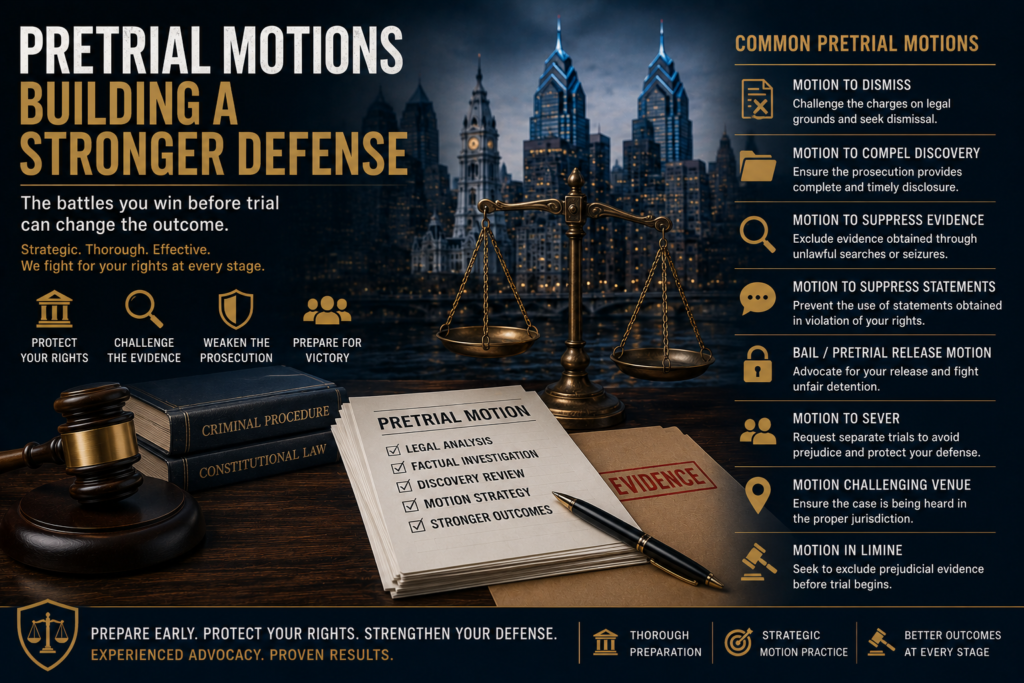
Pretrial Motions in Criminal Cases: Building the Foundation of a Strong Defense
Although television and movies frequently portray jury trials as the central part of a criminal case, a strong majority of criminal cases do not go to trial, especially for cases in Federal court. Some of the most important battles in a criminal case occur long before a jury is selected. The pretrial phase often determines what evidence the prosecution can use, what witnesses may testify, whether charges survive a defense challenge, and ultimately whether a case proceeds to trial at all. Preparing as though a case may go to trial is important from the early stages of a criminal case, but the reality is that most cases will not end up going to trial. NOTE: Certain types of cases, namely homicide and sexual assault cases may be more likely to go to trial.
For experienced criminal defense attorneys, pretrial motions are among the most powerful tools available to protect a client’s constitutional rights, challenge weaknesses in the government’s case, and serve an important role in negotiating in a criminal case. Effective motion practice requires more than legal research and writing. It requires a thorough understanding of criminal procedure, careful review of discovery, extensive factual investigation, and the ability to identify issues that may not be immediately apparent. Knowing the various functions that a motion can serve and when and whether to file certain motions takes strategic thinking, experience, and up-to-date knowledge of case law regarding issues impacting criminal cases.
In both state and federal court, strategic pretrial litigation can dramatically alter the course of a criminal case. Not every criminal case has viable motion issues, but in most cases, filing the right motions at the right time and for the right purpose can make a tremendous difference. But not all motions are created equal. Proper background work, skillful drafting, and effective examination of witnesses at an evidentiary hearing are all important parts of success with motions in a criminal case.
The Importance of Identifying Motion Issues Early
One of the hallmarks of an experienced criminal defense attorney is the ability to recognize potential motion issues as soon as a case begins. Certain types of charges lend themselves to a greater likelihood of certain kinds of motions. Examining how a law enforcement investigation was conducted, as well as familiarity with how certain agencies and officers tend to conduct their investigations can be early indicators that a certain motion will be helpful in a criminal case.
Every criminal case presents unique legal and factual questions. A firearms case may involve Fourth Amendment search and seizure issues. A drug trafficking or conspiracy prosecution may involve wiretap challenges. A fraud investigation may present discovery disputes or challenges to search warrants. A sex crimes case may involve identification issues, expert testimony disputes, or motions concerning electronic evidence. Familiarity with the boilerplate language used in certain warrants, paired with up-to-date knowledge of the law can give the defense a leg up in preparing a defense.
The earlier these issues are identified, the better positioned the defense is to investigate, preserve evidence, and develop effective arguments. A criminal defense attorney who understands the common issues associated with specific case types can often identify weaknesses that less experienced attorneys may overlook.
The Role of Discovery in Motion Practice
Effective pretrial motions often begin with obtaining complete discovery from the prosecution. Filing a motion before having necessary evidence that the prosecution plans to use can result in missteps or weaker arguments. Discovery refers to the evidence and information that prosecutors must disclose to the defense. However, prosecutors do not always voluntarily provide every item that may be helpful to the defense, and some evidence may require specific requests, and even motions to compel discovery to have the court order the prosecution to turn over certain information.
An experienced defense attorney should carefully evaluate what information exists and pursue discovery that may include:
- Police reports;
- Search warrants and affidavits;
- Surveillance footage;
- Body camera recordings;
- Dash camera footage;
- Witness statements;
- Laboratory reports;
- DNA testing records;
- Cell phone records;
- Social media evidence;
- Electronic communications;
- Grand jury materials where permitted.
Obtaining complete discovery is often critical because motion issues frequently arise from evidence that initially appears insignificant but later proves decisive.
The Importance of Thorough Investigation
The defense should never rely solely on the law enforcement investigation and evidence collected. Successful motion practice depends heavily on investigation. The government’s investigation that resulted in the filing of criminal charges against the defendant is often flawed and limited in scope. It will almost never be the case that government investigators actively looked for and preserved evidence that contradicts their theory of the case. A skilled criminal defense attorney should discuss what happened with their client and look to identify investigative steps that might yield favorable evidence. Open and honest attorney-client communications are essential, because the defendant will almost always have information that the prosecution does not. Arming defense counsel with this asymmetry of knowledge can make a tremendous difference in the outcome of a case.
Police reports rarely tell the entire story. Witnesses may provide additional information. Surveillance footage may contradict an officer’s account. Physical evidence may reveal facts not reflected in investigative reports. Witnesses who are unwilling to cooperate with law enforcement may be willing to speak with the defense, and may even be more willing to provide the defense with things like surveillance footage.
A thorough defense investigation may uncover:
- Constitutional violations;
- Inaccuracies in police reports;
- Missing evidence;
- Witness credibility issues;
- Alternative explanations for events;
- Evidence favorable to the defense.
In some cases, investigators may obtain surveillance footage that would otherwise be lost, identify witnesses before memories fade, or discover information that supports suppression arguments. The sooner that the defense can begin its own thorough investigation, the more likely it will identify evidence that helps the defense.
The strongest motions are often built upon both legal analysis and independent factual investigation. Many motions are very fact-specific, and if left up to a police investigation, the facts will favor the prosecution. Officers and agents are familiar with legal standards and are often coached by prosecutors how to frame their presentation of facts and/or conceal facts harmful to their conclusion.
Common Pretrial Motions in Criminal Cases
Motions to Dismiss
A motion to dismiss asks the court to terminate some or all of the charges before trial. It is true that most cases will not be dismissed due to the filing of a motion to dismiss, but there are many cases where it is worthwhile to try to get the case or some of the charges dismissed via pretrial motion. Identifying viable motion issues takes experience, up-to-date knowledge of the law, and a keen eye for issue-spotting. Forcing the prosecution to defend its position early can also provide insight into their theory of the case and potential weaknesses with the case.
Dismissal motions may be based on:
- Insufficient evidence;
- Defective charging documents;
- Violations of constitutional rights;
- Statute of limitations issues;
- Prosecutorial misconduct;
- Lack of jurisdiction.
Although courts do not grant dismissal motions lightly, they can be highly effective when significant legal defects exist. Knowing when not to file a motion is also important. Filing the wrong motion, or filing a motion at the wrong time can have the effect of allowing the prosecution to correct weaknesses in their case before trial.
Motions to Compel Discovery
Discovery disputes are common in criminal cases. State and federal law enforcement and prosecuting agencies often seek to withhold information from the defense. While the government is required to turn over exculpatory information and evidence it intends to use, delays and withholding of evidence frequently occur if it suits the prosecution to do so. Prosecutors are often deliberately slow in turning over evidence to avoid having to abide by speedy trial rights, or will try to get a defendant to plead guilty before the defense identifies weaknesses with the case.
When prosecutors fail to disclose information required by law or court order, the defense may file a motion to compel discovery. An experienced criminal defense attorney will be familiar with what evidence should be available, and should know what to ask for.
These motions may seek:
- Missing reports;
- Surveillance footage;
- Laboratory records;
- Expert materials;
- Witness information;
- Exculpatory evidence.
Compelling complete discovery is often necessary before the defense can properly evaluate suppression issues, prepare for trial, negotiate effectively, or even conduct a complete investigation.
Motions to Suppress Evidence
Motions to suppress evidence are among the most powerful tools available to criminal defense attorneys. Most often these motions seek to exclude evidence obtained in violation of constitutional protections, particularly the Fourth Amendment. In many cases, suppression of unlawfully obtained evidence is the most important step in the defense process. Evidence that is suppressed due to constitutional violations may not be used against a defendant. The evidence remaining after a successful motion to suppress evidence will always put the defendant in a better position than if the evidence had not been suppressed. In many cases, once a suppression motion is granted, the prosecution has no choice but to dismiss the case because they cannot proceed with the evidence available to them.
Interestingly, suppression motions do not require any innocence on behalf of the defendant. In fact, the Fourth Amendment’s exclusionary rule is a prophylactic rule designed to deter rights violations by law enforcement, even where a suspect/defendant is guilty. An innocent person who is searched for no reason will not likely ever get their matter before a court of law. This means that suppression motions are actually the most effective way of protecting everyone from overreach by the police. By not allowing unlawfully obtained evidence to be used against those who are guilty, police are discouraged from violating the rights of all people.
The increased use of body-worn cameras and the prevalence of other cameras (including surveillance cameras and cell phone cameras) has made fact-finding less reliant on officer testimony, and can prove when law enforcement officers violate someone’s rights. Another shift in Fourth Amendment jurisprudence driven by technology is the ever-evolving law surrounding the search of electronic devices such as cell phones, and electronic data stored by third-party service providers. These emerging issues create new possibilities to challenge searches and seizures, but require experience, knowledge, and great attention to detail.
Common suppression issues involve:
- Illegal traffic stops;
- Unlawful searches;
- Invalid search warrants;
- Warrantless searches;
- Improper arrest;
- Lack of probable cause;
- Unlawful searches of electronic devices.
Motions to Suppress Statements
Confessions and admissions often play a major role in criminal prosecutions. Law enforcement officers receive considerable training in getting a suspect to say something incriminating. Although there are complete confessions to a crime, incriminating statements can be much more subtle. While a criminal defense lawyer is likely to advise a client not to make any statements to law enforcement, it is often too late by the time the lawyer is involved.
However, statements obtained in violation of constitutional protections may be inadmissible. The Fifth and Sixth Amendments provide the right against self-incrimination and right to counsel, respectively. Courts have provided guidance on what police may and may not do to elicit statements from a suspect, particularly from someone in police custody. Whether a person is in custody and whether statements are voluntarily made are fact-specific inquiries that require careful review of preserved evidence and thorough investigation to determine.
Common issues include:
- Miranda violations;
- Coerced statements;
- Involuntary confessions;
- Improper interrogation tactics;
- Violations of the right to counsel.
An experienced defense attorney should carefully review recordings, reports, and interrogation circumstances to determine whether suppression arguments exist.
Bail and Pretrial Release Motions
For many defendants, obtaining release from custody is one of the most important objectives in the early stages of a case. Fighting a case – which can take years – from behind bars is very different than fighting the case while on pretrial release. A defendant who is out of custody can better participate in his or her own defense, including having better access to information and the ability to continue to earn a living while a case is pending.
While the Constitution guarantees the accused a presumption of innocence, the practice in most felony courts appears to strongly contradict that presumption. Defendants are often first brought to court in custody, and must aggressively argue for a chance at release. The accused are treated as guilty in many ways in the criminal justice process, but pretrial detention is the most clear example of this paradox.
Bail and detention motions may seek:
- Release on unsecured bail;
- Reduction of bail amounts;
- Modification of release conditions;
- Reconsideration of detention orders.
Early investigation and preparation can significantly improve a defendant’s position during bail hearings and pretrial detention proceedings. Courts consider a variety of factors to determine whether a defendant poses a flight risk or danger to the community. These factors include the charges, prior criminal history, community and family ties, substance use issues, mental health, citizenship, financial means, and more in making release determinations. Familiarity with the law, the judges making the rulings, and skill in advocacy can make a big difference at detention or bail hearings. If a loved one is in custody, consult with a Philadelphia criminal defense lawyer about a strategy for pretrial release.
Motions to Sever
When multiple defendants are charged together, or when multiple offenses are joined in a single case, the defense may seek severance. A motion to sever asks the court to separate defendants or charges into different trials. Severing from other defendants can protect a defendant from being prejudiced by the actions or statements of a co-defendant. Severing charges can allow a jury to focus on one alleged crime at a time, rather than having them hear evidence of two separate crimes.
Severance may be appropriate when:
- Defendants have conflicting defenses;
- Evidence against one defendant may unfairly prejudice another;
- Multiple charges create unfair prejudice;
- A joint trial would compromise constitutional rights.
In certain cases, severance can dramatically improve a defendant’s chances at trial. If a person is charged with committing two robberies, for example, the cumulative effect of hearing about both robberies having some connection to the same defendant may alleviate doubt jurors have about guilt. On the other hand, severance of counts can mean having to win two trials instead of just one.
Whether to move the court to sever defendants or counts is a case-specific tactical decision. Getting a court to grant a motion for severance requires a strong grasp of the law and excellent persuasive writing and oral advocacy.
Venue Challenges
Not every case is filed in the proper court. Most generally, venue is proper in the location where a crime is alleged to have occurred. Crimes involving interstate or international travel, the internet, or occurring over a long period of time can complicate the issue of proper venue. Challenges to venue can include motions for change of venue, or motions to dismiss for improper venue. In both instances, venue motions challenge whether the prosecution has filed charges in the correct jurisdiction. While courts tend to discourage “forum shopping” (parties seeking out a more favorable court), there are statutory provisions that dictate where a case can or must be heard. Because the prosecution files cases, and chooses where to do so, venue challenges are the defendant’s means of ensuring that the prosecution is not unfairly stacking the odds in their favor.
These motions frequently arise in cases involving:
- Multi-county, interstate, or international conduct;
- Internet-related offenses;
- Federal investigations spanning multiple states;
- Conspiracy allegations.
Venue disputes can have significant strategic consequences and may affect where a case is ultimately litigated.
Motions in Limine
Motions in limine seek advance rulings on the admissibility of evidence before trial begins. These motions are typically filed and heard once a case has been set for trial. Determining what evidence to try to exclude before trial can assist with preparing a trial strategy that is not impacted by surprises. It is also an effective way to make sure that the jury does not hear evidence that could have been excluded if addressed before trial.
These motions frequently address:
- Prior bad acts evidence;
- Expert testimony;
- Hearsay statements;
- Photographs and videos;
- Scientific evidence;
- Highly prejudicial material.
Obtaining favorable rulings before trial can significantly shape the evidence the jury ultimately hears and ensure that the defense strategy is not undermined by later rulings on objections.
Strategic Motion Practice Can Change the Outcome
Effective pretrial motions require a combination of legal knowledge, case-specific experience, detailed investigation, and strategic thinking. Simply filing motions is not enough. Successful criminal defense attorneys understand how particular legal issues arise in different types of cases and how to develop factual records that support suppression, dismissal, or exclusion of evidence.
In many criminal cases, the most important victory occurs long before trial. A successful suppression motion may eliminate key evidence. A discovery motion may uncover exculpatory material. A favorable bail ruling may allow a client to remain free while preparing a defense.
For individuals facing criminal charges in state or federal court, experienced counsel who can identify issues early, conduct thorough investigations, pursue complete discovery, and litigate aggressively can make a substantial difference in the outcome of the case. Pretrial motions are often where strong criminal defenses are built—and where cases are won before trial ever begins.
If you are interested to learn more about how pretrial motions might be applicable to your specific case, contact the Loncar Law Firm to schedule a free and confidential consultation with a Philadelphia criminal defense attorney. (215) 267-0500