Criminal Jury Trial Process
Philadelphia Criminal Defense Lawyer
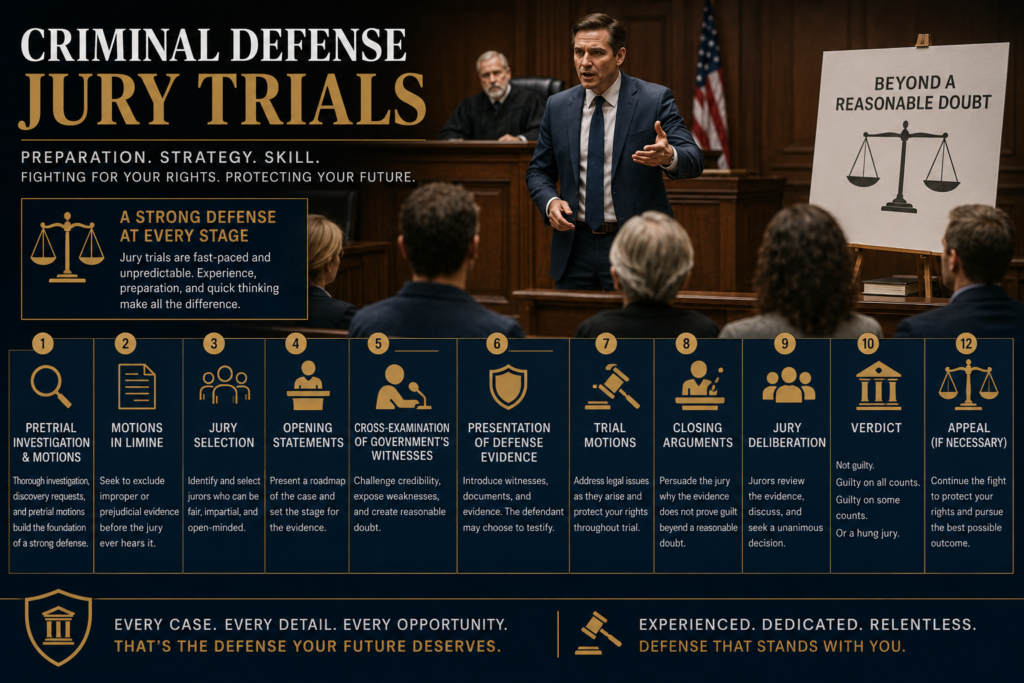
Criminal Jury Trial Process: The Ultimate Test of Preparation, Strategy, and Advocacy
For most people accused of a crime, the idea of a jury trial is intimidating and unfamiliar. Television and movies often portray trials as dramatic courtroom battles decided by a single powerful moment. In reality, successful criminal defense in jury trials is usually the product of months of preparation, strategic decision-making, detailed investigation, and skilled courtroom advocacy. One tremendous advantage that the defense enjoys during criminal jury trials is the very high burden of proof beyond a reasonable doubt. Even apparently strong evidence can fall short of this mark when put to the ultimate test – a jury trial.
In trial – more that at any other stage in a criminal case – it is vital to have an experienced, strategic, and effective advocate on your side. Whether your serious criminal case is in Philadelphia or a surrounding county state court or in Federal Court, it is important to have a criminal defense attorney who is skilled and experienced at trial. If you or a loved one has been arrested or charged with a crime, consult with a Philadelphia criminal defense attorney to get a better understanding of the process and prepare for the best possible results.
While preparation is critical, jury trials are also dynamic and unpredictable. Witnesses may testify differently than expected. New issues can arise unexpectedly. Judges may issue rulings that change the course of the case. Attorneys must think quickly, adapt in real time, and make strategic decisions under pressure. A skilled trial lawyer must be experienced, prepared, and possess the natural ability to put the experience and preparation to use when it matters most. Both the Commonwealth of Pennsylvania (State Court) and Eastern District of Pennsylvania (Federal Court) have seasoned trial prosecutors who have a wealth of training and experience securing criminal convictions.
Whether in Pennsylvania state court or federal court, jury trials remain one of the most important safeguards in the criminal justice system. An experienced trial attorney understands not only the law and evidence, but also how to communicate effectively with jurors and respond to unexpected developments as they occur. If you or a loved one has been charged with a crime in Philadelphia, contact the Loncar Law Firm to schedule a free and confidential consultation. (215) 267-0500
Pretrial Investigation and Trial Preparation
Long before a jury enters the courtroom, effective trial lawyers begin preparing the case. In serious felony cases, it is not uncommon for a trial to take place years after an alleged crime, arrest, or filing of a criminal case. The prosecution most often has a head start to investigation and trial preparation, but there are also significant advantages available to defendants.
A successful jury trial starts with a thorough investigation of the facts. Defense counsel must evaluate the government’s evidence, identify weaknesses in the prosecution’s theory, locate witnesses, preserve favorable evidence, and develop a persuasive defense strategy. Understanding how law enforcement conducts investigations and where they fall short of a jury’s expectations is central to an effective trial defense.
Trial preparation may include:
- Reviewing police reports and discovery;
- Obtaining and examining surveillance footage;
- Interviewing and locating witnesses;
- Consulting expert witnesses;
- Investigating forensic evidence;
- Obtaining cellphone, GPS, or electronic records;
- Developing trial themes and defenses.
Preparation also requires anticipating how the prosecution will present its case and identifying potential issues before they arise at trial. Familiarity with the prosecuting agency, investigating agency, and even specific prosecutors and detectives involved can give your defense lawyer a tremendous advantage in defending you at trial. Open and complete attorney-client communications are imperative as well. In many cases, the defendant knows things that the prosecution does not, and these facts can be very useful to your defense attorney in investigating and preparing the case.
The strongest trial attorneys are often the most prepared attorneys. However, this preparation begins before your specific case. Prior trial training and experience, as well as developing the skills needed to be persuasive to courts and jurors, are prerequisites to being an effective trial lawyer. Knowing how to prepare for a trial is also a skill developed over time, and requiring a natural aptitude for logical and rhetorical persuasion.
Pretrial Motions and Motions in Limine
Many important trial battles occur before the jury ever hears evidence. Specifically, both the prosecution and defense frequently file pretrial motions seeking to suppress unlawfully obtained evidence, exclude improper or irrelevant testimony, compel discovery, or challenge the legality of searches, seizures, and interrogations. These motions are often heard earlier on in a case, and can be vital to trial preparation as well as important in cases that do not go to trial. A successful pretrial motion can result in a complete dismissal of a case, making trial unnecessary. Sometimes, just the filing of a strong motion can result in a case being dismissed by the prosecution or a more favorable plea deal being secured.
As trial approaches, attorneys often file motions in limine. These motions are similar to trial objections, and ask the judge to determine in advance whether certain evidence will be admissible during trial. Getting these rulings early can protect against the jury hearing improper evidence and can help to shape the defense strategy early on. Though a criminal trial can be full of surprises, effective use of the motion in limine process can help to avoid unnecessary surprises. A skilled and experienced trial lawyer can foresee issues that might arise and decide whether dealing with the issue ahead of time is advantageous to the defense strategy.
Common motions in limine may involve:
- Prior criminal history;
- Alleged bad acts;
- Hearsay statements;
- Expert testimony;
- Scientific evidence;
- Photographs or videos;
- Prejudicial evidence with limited relevance.
Successful motions can dramatically affect the evidence the jury ultimately hears and may significantly strengthen the defense position before opening statements even begin.
Jury Selection (Voir Dire)
Where permitted, one of the most important phases of any jury trial is jury selection. Unfortunately, Philadelphia courts and Federal Courts throughout the country do not allow for much (or any) in person Voir Dire to be conducted by counsel. Jury questionnaires, questioning by the judge, and basic biographical information are often the only ways the defense can try to identify potential bias, preconceived opinions, or experiences that may affect their ability to be fair and impartial.
The jury ultimately decides the facts of the case, evaluates witness credibility, and determines whether the government has proven guilt beyond a reasonable doubt. Selecting the right people to – or conversely, making sure the wrong people do not – sit on a jury is very important. In courts that permit broader attorney-led void dire, this is an opportunity to get to know the potential jurors better, and also to plant themes and ideas to be developed further as the trial progresses.
Jurors bring different backgrounds, experiences, and perspectives into the courtroom. Effective trial lawyers understand how to identify jurors who may be receptive to the defense while challenging jurors whose biases could unfairly prejudice the accused. Once a jury is selected, a skilled trial lawyer looks to ensure that the defense strategy will be persuasive to the seated jury, including reading subtle cues tailoring cross-examination, presentation of evidence, and closing arguments to be persuasive to the people who will decide the case.
Jury selection is both an art and a science, requiring careful observation, strategic questioning, and quick decision-making.
Opening Statements
Once the jury is selected, the trial typically begins with opening statements. The prosecution will deliver its opening statement first, describing what it believes the evidence will show. Statements made during opening statements are not evidence, and the jury will be so instructed. It is, however, an important part of the process to introduce the jury to the case and defense. An effective opening statement is a roadmap that helps euros understand what the evidence is expected to show.
What specific issues to raise or not raise can be important strategy considerations, and require carefully considering how the evidence will come out at trial. The best opening statements are clear, engaging, persuasive, and focused on the issues that matter most to the defense.
A strong defense opening statement:
- Establishes credibility;
- Introduces key themes;
- Highlights weaknesses in the government’s case;
- Provides context for the evidence;
- Gives jurors a framework for evaluating testimony.
How to deal with unfavorable evidence during an opening statement can be complex, but must fit into a larger strategy for minimizing or overcoming evidence of guilt. Persuading a jury to look past an eyewitness identification, DNA evidence, or other compelling evidence is essential in most criminal cases.
Cross-Examination of Government Witnesses
Cross-examination is often one of the most important skills a criminal defense attorney can possess. The prosecution has a strategy to present the evidence in a credible and persuasive way. The prosecution bears the burden of proof, meaning it must present witnesses and evidence to establish guilt beyond a reasonable doubt. The defense has the opportunity to challenge that evidence through cross-examination of the prosecution’s witnesses.
By analogy, consider that the prosecution is building a house. It has architectural plans, carefully creates the foundation, and follows the plans to build a house. The defense, having no burden, can expose vulnerabilities in any of these steps to bring the whole house crashing down. Because the prosecution must prove each element of an offense beyond a reasonable doubt, carefully attacking weaknesses in the case can mean the burden is not met.
Effective cross-examination may expose:
- Inconsistencies in testimony;
- Faulty memory;
- Bias or motive;
- Investigative errors and deficiencies;
- Gaps in the government’s evidence;
- Weaknesses in forensic conclusions.
In many cases, the most significant defense evidence comes not from defense witnesses, but from the government’s own witnesses during cross-examination. This can be true of percipient witnesses, police/investigators, and the prosecution’s expert witnesses. Each witness that the government calls will have a purpose to their case. But each witness the government calls can also serve a purpose for the defense with skilled and effective cross-examination.
A skilled trial attorney knows when to challenge a witness aggressively, when to proceed cautiously, and when a simple question can have greater impact than a lengthy confrontation. Though not common, there are even times where not asking a particular witness any questions is the best strategy.
Presentation of Defense Evidence
After the prosecution rests its case, the defense may present evidence. Keeping in mind that it is the prosecution that has the sole burden to prove guilt beyond a reasonable doubt, the defendant is not required to present any evidence or testimony. Certain defenses or defense strategies, however, may require making sure that the jury hears favorable evidence not presented by the prosecution.
Whether to present evidence, whether to have the defendant testify, and what evidence to present are case-specific and should be flexible. Another advantage that the defense has at trial is the opportunity to decide whether to present evidence after seeing how the prosecution’s evidence has come out. Defense evidence can be tailored to address damaging evidence or highlight problems with the prosecution’s case.
Depending on the circumstances, defense evidence may include:
- Fact witnesses;
- Character witnesses where appropriate;
- Expert testimony;
- Documentary evidence;
- Photographs, videos, or electronic records;
- Scientific evidence.
In some cases, the defendant may choose to testify. This is one of the most important strategic decisions in any criminal trial.
Testifying allows the defendant to directly address the jury and explain their version of events. However, it also exposes the defendant to cross-examination by the prosecution.
An experienced trial attorney carefully evaluates the risks and benefits before advising a client regarding testimony.
Trial Motions
Throughout the trial, attorneys must remain alert to legal issues that arise unexpectedly, and be prepared to raise those issues when necessary.
Trial motions may involve:
- Evidentiary objections;
- Requests to strike testimony;
- Motions for mistrial;
- Challenges to expert testimony;
- Requests for limiting instructions;
- Motions for judgment of acquittal.
These decisions often must be made in mere seconds. The ability to recognize legal issues quickly and preserve them for appeal can be critical to protecting a client’s rights.
Closing Arguments
After all evidence has been presented by both sides, attorneys deliver closing arguments. There is a different order in Federal trials (as well as some other states) versus in Pennsylvania state courts. In Federal cases, the government will deliver its closing argument first, followed by a defense closing, and finally a rebuttal by the government. In state court, the defense delivers its closing first, and the prosecution gets the final word, but only gets one closing. The idea behind both orders is that the party with the burden of proof (the prosecution) gets the final word.
The prosecution’s goal in a closing argument is to highlight the evidence it believes proves the defendant guilty of the charges. On the other hand, the defense will aim to highlight problems with the evidence and persuade the jury to look at the evidence critically and hold the government to its very high burden of proof. Though most often the defense will ask the jury to return verdicts of not guilty as to all charges, there are cases which focus on beating the most serious charges or argue for a lesser offense.
A powerful closing argument:
- Highlights reasonable doubt;
- Emphasizes weaknesses in the prosecution’s case;
- Addresses unfavorable evidence;
- Reinforces defense themes;
- Explains why the prosecution failed to meet its burden.
Closing arguments generally represent the final opportunity to persuade jurors before deliberations begin. Occasionally during deliberations, jurors will indicate that they are having a hard time reaching a verdict, and sometimes the court will allow additional argument by both sides.
Deliberation and Verdict
Once closing arguments are completed and the judge provides legal instructions, the jury begins deliberations. Jurors are sent to a jury room, where they review the evidence, discuss witness testimony, evaluate credibility, and attempt to reach a unanimous verdict. Creating moments during cross-examination and closing argument that will stick with jurors as they deliberate is key to a successful result at trial. Giving jurors arguments to support the defense position during deliberations is imperative.
Deliberations can last hours, days, or even weeks depending on the complexity of the case.
Ultimately, the jury may return a verdict of:
- Not guilty;
- Guilty on all charges;
- Guilty on some charges and not others.
In some situations, jurors cannot reach a unanimous decision, resulting in a hung jury and mistrial.
Post-Trial Proceedings
Even after a verdict is returned, important legal work may remain. Defense attorneys may file post-trial motions seeking:
- A new trial;
- Judgment of acquittal;
- Relief based on evidentiary errors;
- Correction of legal mistakes made during trial.
If necessary, counsel may also pursue appellate review.
Experience, Strategy, and Skill Matter
Criminal jury trials are among the most demanding aspects of legal practice. Success requires far more than knowledge of the law. Effective trial advocacy demands preparation, strategic thinking, persuasive communication, and the ability to adapt instantly to unexpected developments. When facing serious criminal charges, it is important to choose a lawyer with experience and skills you can trust.
The best trial lawyers prepare relentlessly while remaining flexible enough to respond to changing circumstances in the courtroom. Whether challenging witnesses, arguing motions, selecting jurors, or delivering closing arguments, every phase of a jury trial presents opportunities to protect a client’s rights and fight for a favorable outcome. Missing any of these opportunities to advance the defense strategy at trial can be the difference between a verdict of guilty or not guilty.
When liberty, reputation, and future opportunities are at stake, experience, strategy, and courtroom skill can make all the difference. Contact the Loncar Law Firm today for a free and confidential consultation with a Philadelphia criminal defense attorney. (215) 267-0500
RELATED PAGES: Criminal Justice Process Overview, Attorney Profile, Practice Areas, Philadelphia Criminal Law Resources, Philadelphia Criminal Defense Attorney, Philadelphia Murder and Homicide Defense Lawyer, Motions to Suppress Evidence, Pretrial Motions, Federal Sentencing
NOTE ABOUT WAIVER TRIALS: In Philadelphia, a majority of state court trials are determined by a judge in a bench trial, rather than a jury trial. The decision to have a judge, rather than a jury, determine the facts of the case belongs to the defendant. Choosing the best way to proceed in your particular case depends on many case-specific factors, including: the charges, the strength of evidence, the defense strategy, as well as timing and other practical considerations. One factor always weighing in favor of a jury trial is the requirement that a criminal verdict must be unanimous; in other words, getting just one of twelve people to believe that the prosecution has not met its burden may be more likely than convincing one of one judges. On the other hand, judges will have had prior exposure to graphic or objectionable evidence, and may be more likely to make their decision based on the facts presented. A waiver trial is typically much faster than a jury trial, and can tend to focus more on a particular point of contention.