
Philadelphia Motorcycle Club Defense Lawyer
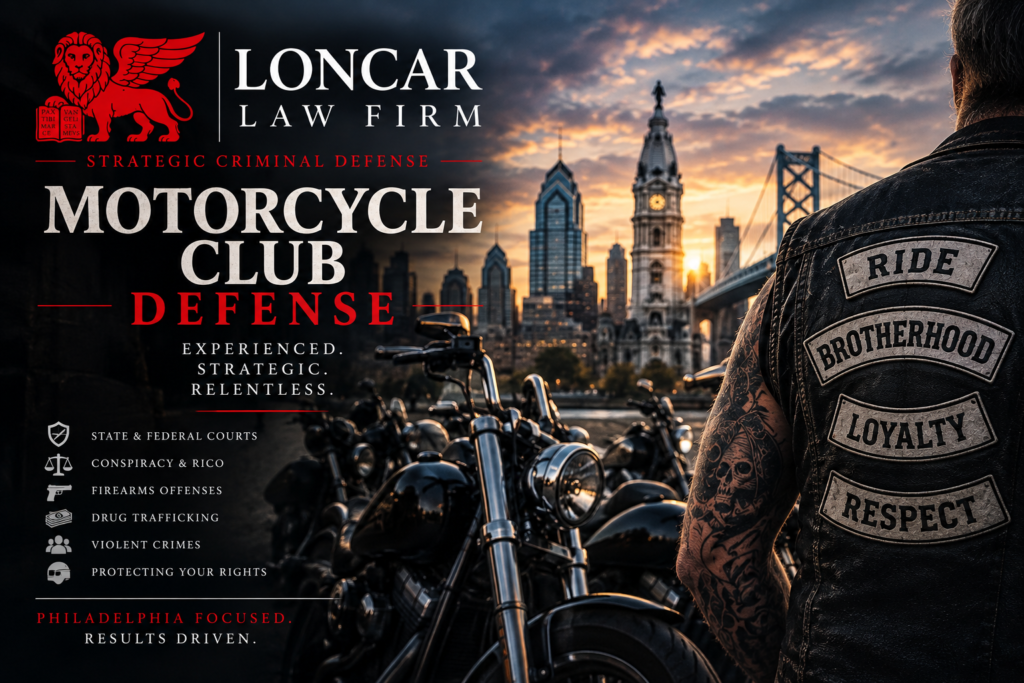
Philadelphia Motorcycle Club Criminal Defense Lawyer
Motorcycle clubs have a long history in Pennsylvania and throughout the United States. For most riders, membership in a motorcycle club is about motorcycles, friendship, community, and a shared culture. Membership in a club—or wearing its colors—is not itself a crime.
Nevertheless, certain motorcycle clubs are classified by federal law enforcement as Outlaw Motorcycle Gangs (OMGs)and receive significant attention from the FBI, Bureau of Alcohol, Tobacco, Firearms and Explosives (ATF), Drug Enforcement Administration (DEA), and federal, state, and local gang task forces.
For a person caught in one of these investigations, the distinction between association and criminal participation can become critically important.
At Loncar Law Firm, we defend serious criminal cases in Philadelphia state and federal courts, including cases involving motorcycle clubs, alleged gangs, conspiracy, firearms offenses, drug trafficking, violent crimes, and federal racketeering allegations.
Are Motorcycle Clubs Considered Criminal Gangs?
Not automatically.
Under Pennsylvania law, 18 Pa.C.S. § 5131(e) defines a “criminal gang” as a formal or informal ongoing organization, association, or group consisting of three or more people that has the commission of criminal or delinquent acts as one of its primary activities.
Pennsylvania separately criminalizes certain methods of recruiting people into criminal gangs under § 5131. Depending upon whether force, intimidation, bodily injury, or serious bodily injury is involved, the offense can range from a misdemeanor to a felony. Penalties can also increase when the person being recruited is younger than 16.
Pennsylvania law additionally provides a criminal-gang sentencing enhancement under 42 Pa.C.S. § 9720.4 for specified crimes of violence and drug-distribution offenses knowingly committed at the direction of, or for the purpose of benefiting, promoting, or furthering the interests of a criminal gang.
Under Pennsylvania’s sentencing guidelines, the criminal-gang enhancement adds 12 months to both the lower and upper limits of the standard sentencing range.
The important distinction is that the law requires more than membership in a motorcycle club. Whether a particular organization satisfies the statutory definition—and whether a particular crime was actually committed to benefit that organization—can become contested issues in a criminal prosecution.
Federal Criminal Street Gang Charges
Federal law has its own definition.
Under 18 U.S.C. § 521, a “criminal street gang” generally must be an ongoing group, club, organization, or association of at least five people that has specified federal offenses as one of its primary purposes, whose members have engaged in a continuing series of qualifying offenses, and whose activities affect interstate or foreign commerce.
Section 521 can increase a sentence by up to 10 additional years, but only if the government establishes the statute’s additional requirements concerning the defendant’s participation, knowledge, intent, qualifying offense, and criminal history.
Motorcycle-club investigations can also lead to far more serious federal charges under statutes that do not depend upon § 521.
RICO, VICAR, and Motorcycle Clubs
Federal prosecutors have repeatedly used the Racketeer Influenced and Corrupt Organizations Act (RICO), 18 U.S.C. §§ 1961–1963, against organizations they characterize as outlaw motorcycle gangs.
RICO allows prosecutors to allege that a motorcycle club constitutes an “enterprise” and that its members or associates participated in the enterprise through a pattern of racketeering activity.
Potential predicate offenses include murder, robbery, extortion, drug trafficking, witness tampering, obstruction, firearms-related crimes, and numerous other offenses.
A substantive RICO offense can carry up to 20 years in federal prison, or potentially life when the violation is based upon racketeering activity carrying a life sentence.
Prosecutors may also use 18 U.S.C. § 1959, commonly known as VICAR—Violent Crimes in Aid of Racketeering. VICAR applies to specified violent crimes committed for payment or for the purpose of gaining entrance to, maintaining, or increasing a person’s position in a racketeering enterprise. Depending upon the underlying offense, penalties can be extraordinarily severe. VICAR murder, for example, can result in life imprisonment.
Conspiracy, Guns, Drugs, and Violent Crimes
Motorcycle-club investigations frequently become conspiracy investigations.
Prosecutors may argue that club meetings, hierarchy, rules, communications, travel, financial transactions, or coordinated activity demonstrate a criminal agreement. But participation in a club is not necessarily participation in a conspiracy.
Federal cases may involve 18 U.S.C. § 371 conspiracy, 21 U.S.C. § 846 drug conspiracy, or 18 U.S.C. § 1962(d) RICO conspiracy. Pennsylvania prosecutors can similarly charge criminal conspiracy under 18 Pa.C.S. § 903.
Other frequently associated allegations include drug trafficking, unlawful firearms possession, firearms trafficking, aggravated assault, robbery, homicide, intimidation, extortion, money laundering, and possession of firearms in furtherance of drug trafficking or violent crimes.
The resulting exposure can be enormous. A federal drug conspiracy involving particular drug types and quantities can carry mandatory minimum sentences of five or ten years and, in some circumstances, a potential maximum sentence of life imprisonment.
Motorcycle Clubs in Pennsylvania and Philadelphia
The Pagans Motorcycle Club has historically received particularly significant law-enforcement attention in Pennsylvania and the Mid-Atlantic. The Department of Justice has classified the Pagans as an outlaw motorcycle gang and has alleged involvement by certain members in offenses including drug trafficking and violent crime.
The Wheels of Soul Motorcycle Club maintains a national presence, while having been started in Philadelphia. Additionally, their mother chapter is located in West Philadelphia. Federal law enforcement has deemed the club a violent gang. Although the membership is predominantly African-American, the Wheels of Soul have members of all races.
The Philadelphia area also has a documented history involving the Warlocks Motorcycle Club. Federal prosecutors in Philadelphia have prosecuted members or associates of the Warlocks in drug-trafficking cases, including a case involving a member of the Chester chapter convicted of participating in a methamphetamine conspiracy operating in Philadelphia and Delaware County.
Other nationally known motorcycle clubs—including the Hells Angels, Outlaws, Mongols, and Sons of Silence—have been identified by federal law enforcement as outlaw motorcycle gangs in various regions of the United States. The presence and activity of individual clubs and chapters can change over time. Needless to say, Philadelphia has a decades long and important history with motorcycle clubs.
Most importantly, a law-enforcement designation placed on an organization does not eliminate the government’s obligation to prove the criminal conduct of the individual defendant. Additionally, that an organization is a gang still must be proven as an element in most cases.
ATF, FBI, and Gang Task Force Investigations
Motorcycle-club cases can involve unusually intensive investigations.
The ATF Philadelphia Field Division specifically identifies armed violent offenders, gangs, and gun traffickers as targets of its violent-crime enforcement efforts and works jointly with federal, state, and local agencies. Its Philadelphia operations include specialized groups focused on firearms trafficking, crime-gun enforcement, HIDTA and violent crime, firearms enforcement, and other violent-crime investigations.
The FBI’s Safe Streets Task Forces also investigate gangs and violent criminal enterprises. Pennsylvania investigations involving the Pagans have demonstrated how extensive these operations can become. In one major federal investigation, authorities used court-authorized Title III wiretaps and ultimately charged 30 members and associates with drug and firearms offenses. The investigation involved the FBI, DEA, Postal Inspection Service, Pennsylvania State Police, Pennsylvania Attorney General, local police departments, and other agencies.
The case was also conducted through the Organized Crime Drug Enforcement Task Forces (OCDETF) program, which coordinates federal, state, and local agencies against organizations believed to be involved in significant drug trafficking, money laundering, gangs, and organized crime.
Investigative techniques in motorcycle-club cases can include confidential informants, cooperating witnesses, undercover officers, controlled purchases, electronic surveillance, wiretaps, GPS and location evidence, social-media monitoring, search warrants, firearm tracing, financial investigation, and searches of clubhouses, homes, vehicles, and electronic devices.
Defending Motorcycle Club Members Against Guilt by Association
One of the central dangers in these cases is guilt by association.
Prosecutors may introduce photographs of defendants wearing club colors, patches, tattoos, motorcycles, clubhouse photographs, social-media posts, nicknames, organizational charts, or evidence of attendance at club meetings and events.
That evidence can create a powerful impression before a jury. But it does not necessarily establish that a defendant committed—or even knew about—a particular crime.
A strong defense therefore requires separating the defendant from the organization-wide narrative presented by the government.
Was the defendant actually part of the alleged criminal agreement? Did the defendant know its objectives? Was an alleged act performed for the club, or was it personal conduct unrelated to the organization? Can statements by other members legally be admitted against the defendant? Did investigators establish probable cause for wiretaps and search warrants? Were searches of homes, vehicles, phones, or clubhouses constitutional? Are cooperating witnesses receiving benefits for their testimony?
These distinctions can determine the outcome of a motorcycle-club prosecution.
Strategic Defense for Serious Motorcycle Club Cases
Motorcycle-club investigations can begin years before arrests occur. By the time indictments are returned, federal agents may have accumulated thousands of intercepted communications, surveillance reports, photographs, financial records, firearm traces, social-media records, and information from confidential sources.
Defending these cases requires more than responding to the government’s characterization of an organization. It requires analyzing the evidence against each individual defendant and forcing the prosecution to prove every element of every charge.
Loncar Law Firm provides strategic criminal defense representation in Philadelphia for serious state and federal cases involving motorcycle clubs, alleged gang activity, RICO and conspiracy charges, firearms offenses, drug trafficking, homicide, violent crimes, and other complex criminal prosecutions.