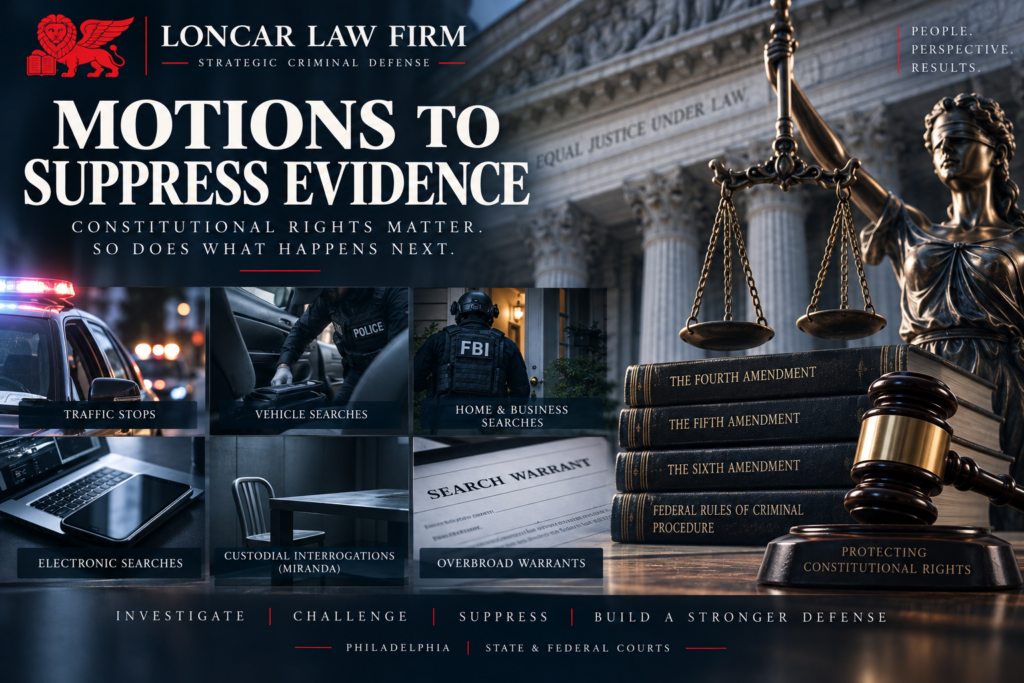
Motions to Suppress Evidence
Philadelphia Criminal Defense Attorney
Motions to Suppress Evidence in Federal and Pennsylvania Criminal Cases
In many criminal cases, the most important battle occurs before a jury is ever selected. A successful motion to suppress evidence can prevent prosecutors from using illegally obtained physical evidence, electronic data, statements, or other evidence against a defendant. In some cases, suppression can substantially weaken the prosecution or result in dismissal of the charges altogether. Discuss the possibility of filing motions to suppress evidence with a lawyer.
Suppression litigation is particularly important in serious state and federal cases involving drugs, firearms, homicide, fraud, conspiracy, and other offenses in which the government’s case depends heavily on evidence obtained through searches, seizures, surveillance, or interrogation.
At Loncar Law Firm, suppression issues are evaluated as part of a broader defense strategy: investigating how the evidence was obtained, examining the government’s justification for its actions, researching the applicable constitutional law, and litigating contested factual issues when necessary.
The Fourth Amendment: Illegal Searches and Seizures
The Fourth Amendment to the United States Constitution protects against unreasonable searches and seizures and generally requires warrants to be supported by probable cause and to particularly describe the place to be searched and the persons or things to be seized. When the government obtains evidence through a search or seizure that violates the Fourth Amendment, the exclusionary rule may prevent prosecutors from using that evidence at trial. Most motions to suppress evidence are rooted in Fourth Amendment violations.
Fourth Amendment issues arise in many different circumstances.
Unlawful Traffic Stops
A traffic stop is a seizure under the Fourth Amendment. Police therefore need a lawful basis to initiate the stop. While an arrest requires probable cause, brief investigatory detentions such as traffic stops only require reasonable suspicion. Reasonable suspicion is a lower standard, but still cannot be justified by merely a hunch. If the government cannot establish that the officer who conducted a traffic stop had reasonable suspicion to do so, the entire stop must be suppressed.
Suppression litigation may challenge whether the officer actually observed the traffic violation claimed in a police report, whether reasonable suspicion otherwise existed, or whether a lawful traffic stop was improperly extended to investigate unrelated criminal activity.
These cases frequently require careful examination of body-camera footage, dash-camera video, dispatch records, GPS information, police reports, witness testimony, and the timing of events. What appears justified from a written report can look very different when compared with objective video or electronic evidence. Where there is no objective evidence, the defense may need to rely upon inconsistencies and unsupported statements by police.
Illegal Vehicle Searches
A lawful traffic stop does not automatically authorize police to search the vehicle.
Depending upon the circumstances, prosecutors may attempt to justify a vehicle search based on probable cause, consent, a search incident to arrest, an inventory search, or another recognized exception to the warrant requirement.
Defense counsel should determine exactly what officers knew before the search occurred. The government ordinarily cannot justify a search after the fact based upon incriminating evidence discovered during the search itself.
Homes and Businesses
Fourth Amendment protection is especially significant when police enter and search a home.
Searches of homes and businesses can raise questions concerning probable cause, the scope of a warrant, consent, exigent circumstances, and whether officers remained within the areas the warrant authorized them to search.
Even when officers possess a warrant, the analysis does not end there. A defense attorney may challenge whether the affidavit actually established probable cause, whether material information was omitted or misrepresented, whether the warrant was sufficiently particular, or whether officers exceeded its authorized scope.
Overbroad Warrants and Electronic Searches
Modern criminal investigations frequently involve enormous quantities of digital evidence: cell phones, computers, cloud accounts, emails, social-media accounts, photographs, location data, and electronic communications.
The Supreme Court recognized the extraordinary privacy interests associated with smartphones in Riley v. California, holding that police ordinarily must obtain a warrant before searching the digital contents of a cell phone seized incident to arrest.
But obtaining a warrant does not necessarily make every digital search constitutional.
The Fourth Amendment requires particularity. In an electronic-evidence case, the defense may examine the categories of information the warrant authorized investigators to seize, the probable cause supporting those categories, the devices and accounts covered by the warrant, and whether investigators exceeded the warrant’s permissible scope.
A warrant should not become a license for an unrestricted search through a person’s entire digital life.
Fifth Amendment, Miranda, and Statements
Suppression motions also frequently involve statements made to law enforcement.
Under Miranda v. Arizona, custodial interrogation generally triggers the familiar requirement that police advise a suspect of the right to remain silent and the right to counsel before questioning. A defense attorney may challenge whether Miranda warnings were required, whether adequate warnings were actually provided, whether a purported waiver was knowing and voluntary, and whether officers continued questioning after the defendant properly invoked protected rights. The exclusionary rule can prevent the use of statements obtained in violation of applicable constitutional protections.
Voluntariness presents a related but distinct issue. Even where officers recite Miranda warnings, the circumstances surrounding an interrogation can raise questions about whether a statement was actually voluntary.
The Sixth Amendment Right to Counsel
The Sixth Amendment can provide another basis for suppressing statements after the right to counsel has attached in a criminal prosecution.
In Massiah v. United States, for example, the Supreme Court held that the defendant’s Sixth Amendment rights were violated when federal agents deliberately elicited incriminating statements from him after indictment and outside the presence of counsel.
The precise constitutional theory matters. A Miranda issue, a voluntariness challenge, and a post-indictment Sixth Amendment violation are related concepts, but they are not interchangeable. Effective suppression litigation requires identifying the correct constitutional protection and applying it to the specific circumstances of the interrogation.
Investigating a Motion to Suppress
A strong suppression motion begins with investigation—not simply legal research.
Defense counsel should reconstruct exactly what happened before, during, and after the challenged search, seizure, or interrogation. That may require obtaining body-camera and dash-camera footage, photographs, search warrants and affidavits, police reports, property receipts, dispatch communications, forensic reports, electronic-device extraction records, interrogation recordings, surveillance footage, and testimony from independent witnesses.
Timelines can be particularly important. A difference of several minutes may determine whether officers developed probable cause before or after a search or whether a traffic stop was extended beyond its lawful purpose.
The goal is to compare what the officers said happened with what the evidence demonstrates actually happened.
Preparing the Motion, Government Response, and Defense Reply
Once the facts have been developed, defense counsel can prepare a written motion identifying the challenged evidence, relevant facts, constitutional violation, and legal authority supporting suppression.
The prosecution typically responds with its own factual and legal arguments. Depending upon the case, the government may contend that no constitutional violation occurred or invoke doctrines such as consent, good faith, independent source, inevitable discovery, or attenuation.
A defense reply can then address those arguments, clarify disputed issues, and explain why the government’s exceptions do not apply.
This written litigation is important because it defines the constitutional issues that the judge may ultimately have to decide.
The Suppression Hearing
When material facts are disputed, the court may conduct an evidentiary hearing.
Police officers, federal agents, witnesses, investigators, or other individuals may testify. Defense counsel can cross-examine government witnesses and confront their testimony with video, reports, photographs, records, prior statements, or other evidence.
The hearing can therefore be as important as the written motion itself. Credibility, inconsistencies, timing, and details that seemed minor on paper can become critical under examination. Officers are frequently the only witnesses, and have a strong bias against the defense. Use of body cameras, prior testimony, reports to catch inconsistencies is critical to success in most suppression hearings.
After considering the evidence and legal arguments, the judge determines whether the challenged evidence is admissible.
Fruit of the Poisonous Tree
Suppression sometimes extends beyond the evidence obtained during the initial constitutional violation.
Under the doctrine commonly called “fruit of the poisonous tree,” evidence derived from unlawful government conduct may also be subject to exclusion. In Wong Sun v. United States, the Supreme Court explained that the exclusionary principle can apply to both direct and indirect products of an unlawful search or seizure.
For example, an unlawful search might lead investigators to additional physical evidence, witnesses, or statements. The defense may argue that those later discoveries resulted from exploitation of the original illegality.
But the doctrine is not absolute. Evidence may remain admissible under principles including independent source, inevitable discovery, attenuation, and good-faith reliance in appropriate circumstances.
Does Suppression Mean the Case Is Dismissed?
Sometimes—but not automatically.
A successful suppression motion can fundamentally change a criminal case. If the suppressed evidence is essential to proving the charges, prosecutors may be unable to proceed, potentially resulting in dismissal, a substantially improved plea resolution, or an acquittal if the case continues to trial.
But suppression of evidence is not the same thing as dismissal of charges.
If prosecutors possess other evidence that was independently and lawfully obtained, they may still proceed with the prosecution. Suppressing drugs discovered during an unlawful search, for example, does not necessarily suppress independent testimony or other evidence having no legally sufficient connection to the constitutional violation.
The real question is therefore not merely whether a suppression motion succeeds, but what remains of the government’s case after the challenged evidence is excluded. Even if some evidence survives a suppression motion, having some evidence suppress will make the trial better for the defense. More on jury trials
Strategic Criminal Defense and Suppression Litigation
Motions to suppress can be among the most consequential tools available to the defense. Successful litigation requires early investigation, careful constitutional analysis, persuasive written motions, effective cross-examination, and the ability to identify weaknesses in the government’s account of how evidence was obtained.
For serious criminal cases, those issues should be investigated from the beginning—not discovered on the eve of trial. Challenging admissibility of evidence through suppression motions can have many good impacts on a case. Of course the best out these outcomes is suppression of harmful evidence, but there are other benefits as well. Additionally, a strong suppression motion might affect the plea offer the prosecution will make. Moreover, questioning law enforcement about how they gathered evidence might expose weaknesses that can be used later at trial – even if suppression is not granted.
Loncar Law Firm provides strategic criminal defense representation in Philadelphia state and federal cases. These services frequently include challenges to unlawful traffic stops, vehicle and home searches, search warrants, electronic searches, illegally obtained statements, and other violations of constitutional rights. Consult with an experienced criminal defense attorney. Call 215-267-0500 to schedule your free and confidential call or meeting with a Philadelphia criminal defense lawyer.
Related Pages
Criminal Pre-Trial Motions | Pre-Indictment Representation
Jury Trials | Philadelphia Criminal Defense Lawyer
Overview of the Criminal Justice Process
Loncar Law Firm, PC Practice Areas
Federal Sentencing | Federal Drug Trafficking | Federal Gun Cases
Pennsylvania Drug Trafficking | Pennsylvania Weapons Offenses