Federal Sentencing
Philadelphia Federal Criminal Defense Lawyer
Federal Sentencing: Understanding the Guidelines, Plea Process, and Sentencing Hearing
A federal criminal case does not end when a defendant pleads guilty or is convicted at trial. In many cases, some of the most important advocacy occurs during the sentencing process. Whether a person is convicted at trial or by plea, there can still be very significant variation in the actual sentence imposed. Affecting that sentence takes experience, understanding of new developments in the laws and guidelines, and effective advocacy for clients throughout all stages of a case – including sentencing. Avoiding a conviction (and therefore avoiding sentencing) is of course always best. But in the many cases that do result in some conviction, effective representation at sentencing is vital.
Federal sentencing is complicated. The court must consider the United States Sentencing Guidelines, statutory mandatory minimum and maximum sentences, the defendant’s criminal history, the circumstances of the offense, mitigating evidence, and the sentencing factors established by Congress in 18 U.S.C. § 3553(a). Although the Guidelines are advisory, they remain an important starting point in virtually every federal sentencing.
For that reason, effective federal sentencing advocacy should begin well before the day a defendant appears before the judge.
The Federal Sentencing Guidelines
The United States Sentencing Guidelines provide a framework for calculating an advisory sentencing range. The calculation generally involves two major components: the defendant’s Total Offense Level and Criminal History Category. An experienced and skilled federal criminal defense lawyer will know the guidelines and how to apply them to a particular case.
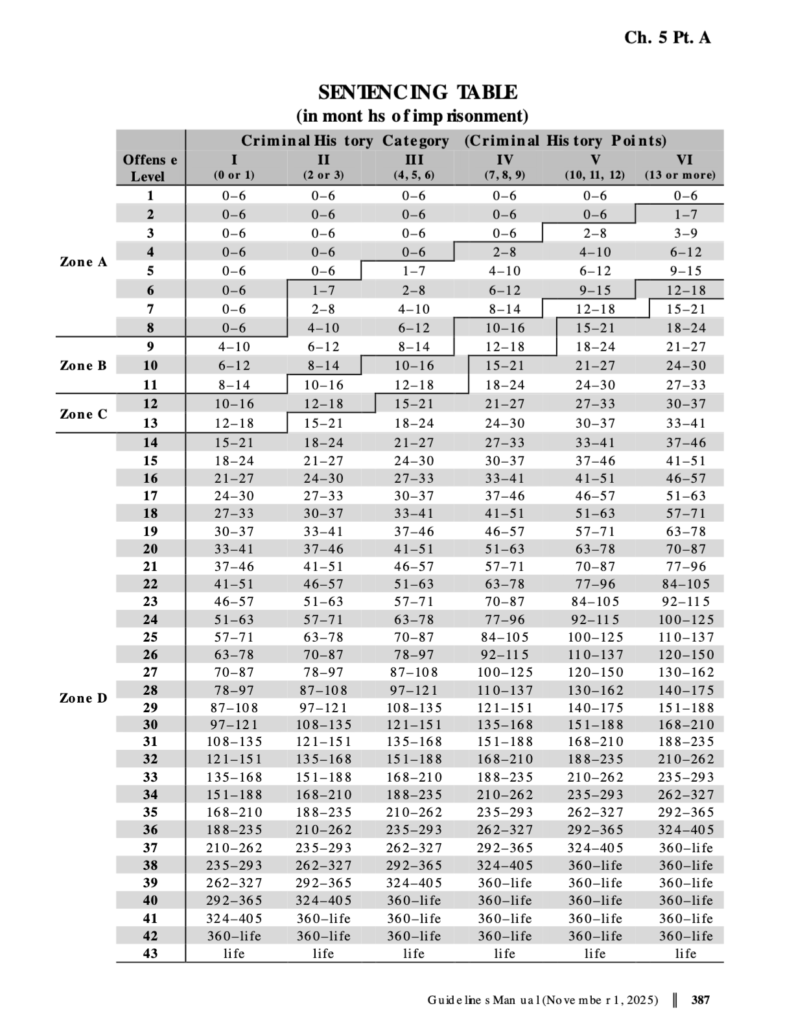
Once those numbers are determined, they are placed on the Sentencing Table to produce an advisory range expressed in months of imprisonment. As cases are considered more serious (higher offense level), or a defendant has more prior criminal history (higher criminal history category), the sentence range recommended by the guidelines goes up.
The Guidelines are just that—advisory. The sentencing judge must consider the guideline range but ultimately impose an appropriate sentence after considering all of the factors contained in § 3553(a), including the nature of the offense, the defendant’s history and characteristics, deterrence, protection of the public, available sentences, sentencing disparities, and restitution. Accordingly, it is important to correctly calculate the guidelines, but also look for reasons to vary outside of the range.
Calculating the Offense Level
Guideline calculations can become extraordinarily complicated.
The process ordinarily begins with a base offense level determined by the offense of conviction and applicable guideline. From there, the level can increase or decrease depending upon offense characteristics and adjustments.
For example, a federal firearms case might involve adjustments based upon the number or type of firearms or their connection to another offense. Fraud cases can turn heavily on the calculation of financial loss. Drug cases may depend upon drug type, quantity, and purity. Other adjustments can involve a defendant’s role in the offense, obstruction of justice, use of sophisticated means, or other circumstances. Each type of case has different factors influencing the offense level.
The Guidelines also incorporate the concept of relevant conduct, meaning sentencing exposure is not necessarily determined solely by the conduct described in the count to which the defendant pleaded guilty. Even conduct underlying dismissed charges can sometimes remain relevant to the guideline calculation.
This is one reason guideline analysis should be part of plea negotiations—not something considered for the first time after a guilty plea. The charge of conviction, the factual basis, and other agreements regarding a sentence can be part of a negotiated plea deal.
Criminal History Categories
The second axis of the Sentencing Table is the defendant’s Criminal History Category.
The Guidelines assign criminal-history points based upon qualifying prior sentences and other applicable rules. Those points generally place a defendant into one of six categories, from Category I through Category VI.
The difference can be substantial. Two defendants with exactly the same offense level may face very different advisory ranges because of their criminal histories.
Determining whether prior convictions were correctly counted—and whether the resulting criminal-history category fairly represents the defendant’s actual history—can therefore be an important part of sentencing advocacy. Prior convictions may be too old, or otherwise not counted against a defendant’s criminal history points. Getting court records from other jurisdictions can sometimes affect criminal history computation.
Understanding the Sentencing Chart
The federal Sentencing Table contains 43 offense levels vertically and six Criminal History Categories horizontally. The intersection produces the advisory guideline imprisonment range.
For example, an offense level of 20 combined with Criminal History Category I produces a considerably lower range than the same offense level combined with Category VI.
But finding the box on the chart is not the end of the analysis. Statutory minimums and maximums can alter the sentence that is legally available, and the court must still consider the broader § 3553(a) sentencing factors.
View the current U.S. Sentencing Guidelines Manual
Common Variances
Post-Arrest Rehabilitation
Youth / Lack of Prior Criminal History
Mental Heath or Substance Abuse Issues
Difficult or Disadvantaged Upbringing
Employment History / Military Service
Community and Family Ties & Support
Variances From the Sentencing Guidelines
Because the Guidelines are advisory, the defense can request a sentence outside the calculated range. This is authorized by most plea agreements, and can apply in cases where a defendant is convicted at trial.
A variance generally asks the judge to impose a different sentence based upon the statutory factors in § 3553(a). Those factors expressly include both the circumstances of the offense and the defendant’s individual history and characteristics. The governing statute directs courts to impose a sentence sufficient, but not greater than necessary, to accomplish the purposes of federal sentencing.
A persuasive variance argument can involve circumstances that a numerical guideline calculation does not adequately capture: family responsibilities, childhood circumstances, military service, employment history, rehabilitation, addiction treatment, mental or physical health issues, age, community contributions, the defendant’s limited role in an offense, unusually severe collateral consequences, or disparities among similarly situated defendants.
The goal is to present the judge with the person behind the guideline calculation.
Mandatory Minimum Sentences
Mandatory minimums create a different problem.
Certain federal offenses require minimum terms of imprisonment established by Congress. They are particularly common in serious drug and firearm prosecutions.
Ordinarily, a judge cannot simply vary below an applicable statutory minimum based on the § 3553(a) factors. There are, however, important exceptions. In qualifying drug cases, the statutory safety valve under 18 U.S.C. § 3553(f) can permit sentencing without regard to an otherwise applicable mandatory minimum. A government motion based upon substantial assistance can also provide authority for a sentence below a statutory minimum.
Determining whether a mandatory minimum applies—and whether there is a lawful path around it—can therefore be one of the most consequential issues in the entire case.
Plea Bargaining and Early Acceptance of Responsibility
Plea negotiations can have enormous sentencing consequences.
A negotiated resolution may affect the charges of conviction, statutory sentencing exposure, disputed guideline provisions, and the parties’ sentencing positions. But plea agreements require careful analysis because dismissing a charge does not necessarily prevent related conduct from being considered as relevant conduct at sentencing.
The Guidelines also provide a reduction for acceptance of responsibility. Under §3E1.1, a defendant who clearly demonstrates acceptance ordinarily receives a two-level reduction. When the offense level is 16 or higher, an additional one-level reduction may be available upon the government’s motion when the defendant timely communicates an intention to plead guilty and thereby permits the government to avoid substantive trial preparation.
The timing and terms of a plea can therefore matter.
Mitigation Should Begin Before Sentencing
A common mistake is treating mitigation as something that begins shortly before the sentencing hearing.
Effective mitigation can begin much earlier.
During plea negotiations, defense counsel may be able to explain circumstances that affect charging decisions, plea terms, guideline positions, or the government’s ultimate sentencing recommendation. By sentencing, counsel should have developed a detailed understanding of the client’s life rather than merely relying on the criminal case file.
Mitigation can include medical and treatment records, employment history, military records, educational achievements, evidence of rehabilitation, family circumstances, community involvement, character letters, psychological evaluations when appropriate, and a concrete reentry plan.
The sentencing memorandum can then place those facts into the legal framework of § 3553(a), explaining why the requested sentence is sufficient without being greater than necessary.
The Presentence Report, Sentencing Memorandum, and Sentencing Hearing
After conviction, the United States Probation Office ordinarily conducts a presentence investigation and prepares a Presentence Investigation Report (PSR). The report can address the offense, guideline calculations, criminal history, personal background, financial circumstances, and other information relevant to sentencing.
Under the current Guidelines procedures, the PSR generally must be disclosed at least 35 days before sentencing, absent waiver. The parties ordinarily have 14 days after receiving it to submit written objections. Those objections matter. A disagreement over drug quantity, loss amount, criminal history, role in the offense, relevant conduct, or another enhancement can substantially change the advisory range.
Prior to the sentencing hearing, the parties each submit a sentencing memorandum, arguing for their position at sentencing. A powerful sentencing memorandum can highlight reasons for the court to impose a lower sentence. There are sentencing factors, and there are categories of bases courts have frequently used to justify lighter sentences. Pointing out how these factors apply, and telling the client’s story as a real person can have a big impact on the final outcome in a federal criminal case.
At the sentencing hearing, the court may resolve disputed factual and guideline issues. The parties must receive an adequate opportunity to present information concerning genuinely disputed sentencing factors, and sentencing information may sometimes be considered even though it would not satisfy the evidentiary rules governing a criminal trial, provided it possesses sufficient indicia of reliability.
Defense counsel can also present the § 3553(a) argument, address mitigation, respond to the government’s position, and advocate for the requested sentence. The defendant generally has an opportunity to speak directly to the judge through allocution.
Federal Sentencing Requires a Strategy
A federal sentence can affect years—or decades—of a person’s life. Sentencing advocacy should therefore begin long before everyone enters the courtroom for the final hearing.
The strongest approach combines careful guideline analysis, strategic plea negotiations, challenges to improper enhancements, development of mitigation, objections to the Presentence Report, a persuasive sentencing memorandum, and effective advocacy before the sentencing judge.
Loncar Law Firm provides strategic criminal defense representation in Philadelphia federal criminal cases, including plea negotiations, federal sentencing, sentencing-guideline disputes, mitigation, mandatory-minimum cases, and sentencing hearings. Schedule a free and confidential consultation with a Philadelphia criminal defense lawyer. 215-267-0500.